select the correct answer.\nin which reaction is precipitation occurring?\na. mgcl₂(aq) + cuso₄(aq) →…
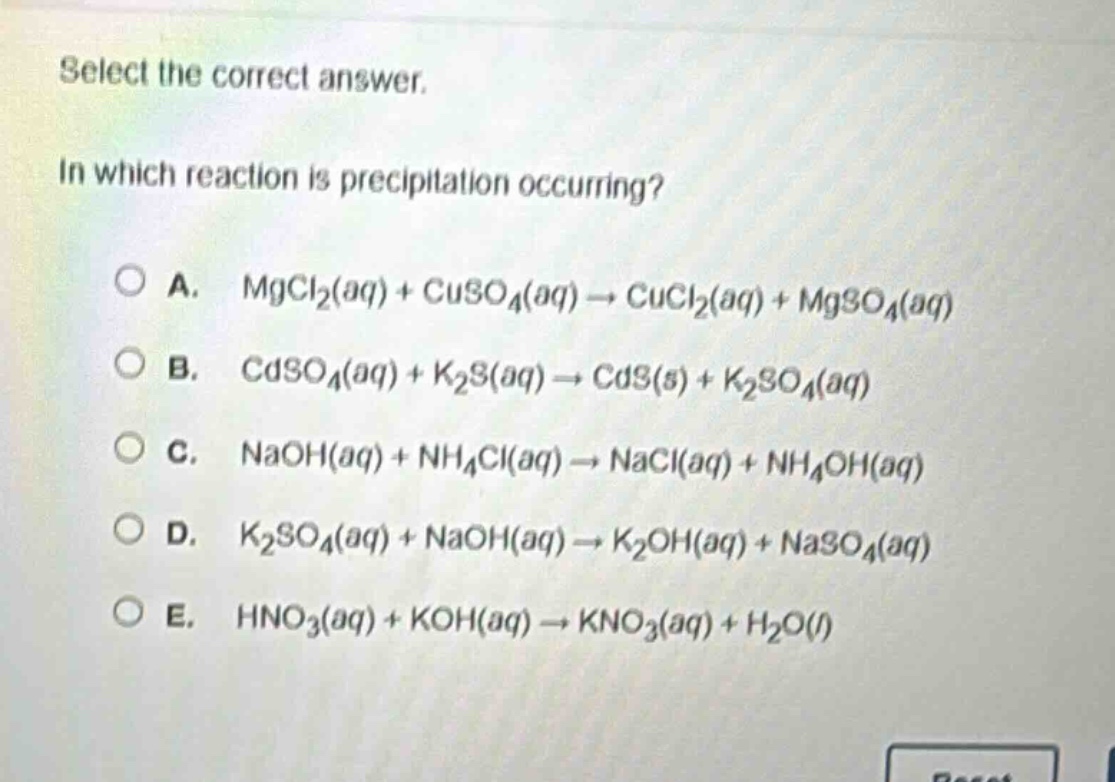
select the correct answer.\nin which reaction is precipitation occurring?\na. mgcl₂(aq) + cuso₄(aq) → cucl₂(aq) + mgso₄(aq)\nb. cdso₄(aq) + k₂s(aq) → cds(s) + k₂so₄(aq)\nc. naoh(aq) + nh₄cl(aq) → nacl(aq) + nh₄oh(aq)\nd. k₂so₄(aq) + naoh(aq) → k₂oh(aq) + naso₄(aq)\ne. hno₃(aq) + koh(aq) → kno₃(aq) + h₂o(l)
Answer
Explanation:
Step1: Recall precipitation reaction concept
A precipitation reaction forms an insoluble solid (precipitate) from aqueous - phase reactants.
Step2: Analyze option A
All products ($CuCl_2(aq)$ and $MgSO_4(aq)$) are aqueous, no precipitate.
Step3: Analyze option B
$CdS(s)$ is a solid precipitate formed from aqueous $CdSO_4(aq)$ and $K_2S(aq)$.
Step4: Analyze option C
All products ($NaCl(aq)$ and $NH_4OH(aq)$) are aqueous, no precipitate.
Step5: Analyze option D
The products $K_2OH(aq)$ and $NaSO_4(aq)$ are incorrect (should be $KOH(aq)$ and $Na_2SO_4(aq)$), and all are aqueous if corrected, no precipitate.
Step6: Analyze option E
The products $KNO_3(aq)$ and $H_2O(l)$ are not a solid - phase precipitate.
Answer:
B. $CdSO_4(aq)+K_2S(aq)\rightarrow CdS(s)+K_2SO_4(aq)$