select the correct answer. which two particles can form an ionic bond with each other? a. a negative oxygen…
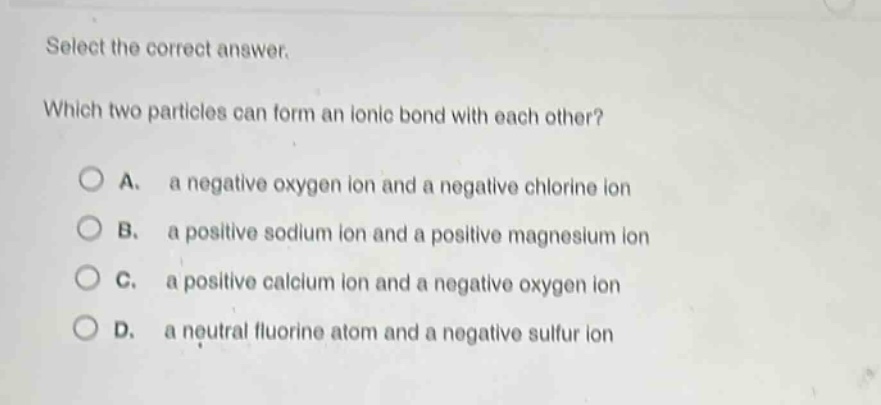
select the correct answer. which two particles can form an ionic bond with each other? a. a negative oxygen ion and a negative chlorine ion b. a positive sodium ion and a positive magnesium ion c. a positive calcium ion and a negative oxygen ion d. a neutral fluorine atom and a negative sulfur ion
Answer
Answer:
C. a positive calcium ion and a negative oxygen ion
Explanation:
Step1: Recall ionic - bond concept
Ionic bonds form between oppositely - charged ions.
Step2: Analyze option A
Two negative ions (negative oxygen and negative chlorine) will repel each other and not form an ionic bond.
Step3: Analyze option B
Two positive ions (positive sodium and positive magnesium) will repel each other and not form an ionic bond.
Step4: Analyze option C
A positive calcium ion ($Ca^{2 + }$) and a negative oxygen ion ($O^{2 - }$) are oppositely - charged and can form an ionic bond.
Step5: Analyze option D
A neutral fluorine atom has no charge and cannot form an ionic bond with a negative sulfur ion.