select all the correct answers.\nthe electron configurations of some elements are given. based on the…
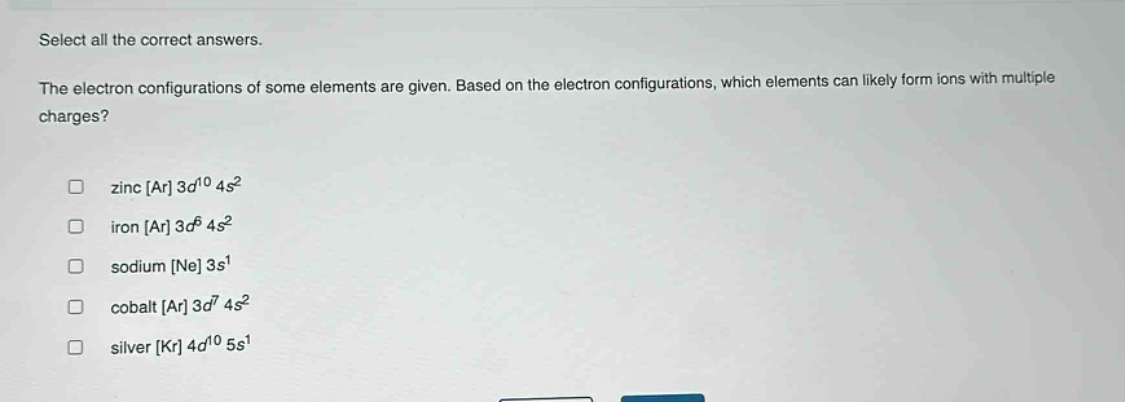
select all the correct answers.\nthe electron configurations of some elements are given. based on the electron configurations, which elements can likely form ions with multiple charges?\n\n□ zinc ar 3d^{10} 4s^{2}\n□ iron ar 3d^{6} 4s^{2}\n□ sodium ne 3s^{1}\n□ cobalt ar 3d^{7} 4s^{2}\n□ silver kr 4d^{10} 5s^{1}
Answer
Explanation:
Step1: Understand ion - formation with multiple charges
Elements with partially filled d - orbitals often form ions with multiple charges. This is because electrons from both the outer s - orbital and the d - orbital can be lost during ionization.
Step2: Analyze zinc
Zinc has an electron configuration of [Ar] 3d$^{10}$4s$^{2}$. The d - subshell is completely filled. It usually forms a + 2 ion by losing the two 4s electrons and does not form ions with multiple charges.
Step3: Analyze iron
Iron has an electron configuration of [Ar] 3d$^{6}$4s$^{2}$. It can lose the two 4s electrons to form Fe$^{2 + }$, and can also lose one more electron from the 3d - subshell to form Fe$^{3+}$. So, it can form ions with multiple charges.
Step4: Analyze sodium
Sodium has an electron configuration of [Ne] 3s$^{1}$. It usually loses the single 3s electron to form a Na$^{+}$ ion and does not form ions with multiple charges.
Step5: Analyze cobalt
Cobalt has an electron configuration of [Ar] 3d$^{7}$4s$^{2}$. It can lose the two 4s electrons to form Co$^{2+}$, and can also lose one more electron from the 3d - subshell to form Co$^{3+}$. So, it can form ions with multiple charges.
Step6: Analyze silver
Silver has an electron configuration of [Kr] 4d$^{10}$5s$^{1}$. It usually loses the 5s electron to form Ag$^{+}$, but can also lose electrons from the 4d - subshell in some cases to form ions with other charges. So, it can form ions with multiple charges.
Answer:
iron [Ar] 3d$^{6}$4s$^{2}$, cobalt [Ar] 3d$^{7}$4s$^{2}$, silver [Kr] 4d$^{10}$5s$^{1}$