select all of the pairs of aqueous solutions that will form a precipitate when mixed.\n□ na₂so₄ + koh\n□…
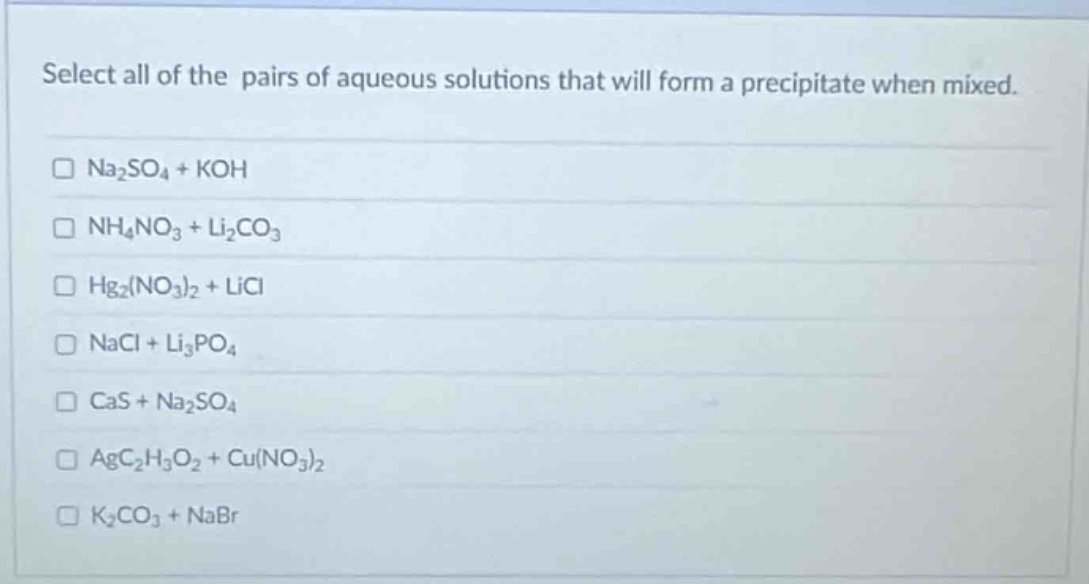
select all of the pairs of aqueous solutions that will form a precipitate when mixed.\n□ na₂so₄ + koh\n□ nh₄no₃ + li₂co₃\n□ hg₂(no₃)₂ + licl\n□ nacl + li₃po₄\n□ cas + na₂so₄\n□ agc₂h₃o₂ + cu(no₃)₂\n□ k₂co₃ + nabr
Answer
Explanation:
Step1: Recall solubility rules
Use solubility rules to predict products of double - displacement reactions and their solubility.
Step2: Analyze $\mathrm{Na_2SO_4}+\mathrm{KOH}$
The possible products are $\mathrm{NaOH}$ and $\mathrm{K_2SO_4}$. Both are soluble, no precipitate.
Step3: Analyze $\mathrm{NH_4NO_3}+\mathrm{Li_2CO_3}$
The possible products are $\mathrm{(NH_4)_2CO_3}$ and $\mathrm{LiNO_3}$. Both are soluble, no precipitate.
Step4: Analyze $\mathrm{Hg_2(NO_3)_2}+\mathrm{LiCl}$
The reaction gives $\mathrm{Hg_2Cl_2}$ and $\mathrm{LiNO_3}$. $\mathrm{Hg_2Cl_2}$ is insoluble, forms a precipitate.
Step5: Analyze $\mathrm{NaCl}+\mathrm{Li_3PO_4}$
The possible products are $\mathrm{Na_3PO_4}$ and $\mathrm{LiCl}$. Both are soluble, no precipitate.
Step6: Analyze $\mathrm{CaS}+\mathrm{Na_2SO_4}$
The reaction gives $\mathrm{CaSO_4}$ and $\mathrm{Na_2S}$. $\mathrm{CaSO_4}$ is slightly soluble and can form a precipitate under certain conditions.
Step7: Analyze $\mathrm{AgC_2H_3O_2}+\mathrm{Cu(NO_3)_2}$
The possible products are $\mathrm{AgNO_3}$ and $\mathrm{Cu(C_2H_3O_2)_2}$. Both are soluble, no precipitate.
Step8: Analyze $\mathrm{K_2CO_3}+\mathrm{NaBr}$
The possible products are $\mathrm{KBr}$ and $\mathrm{Na_2CO_3}$. Both are soluble, no precipitate.
Answer:
$\mathrm{Hg_2(NO_3)_2}+\mathrm{LiCl}$, $\mathrm{CaS}+\mathrm{Na_2SO_4}$