selected properties of antimony (sb) and iodine (i) are listed in the table below. which predictions can…
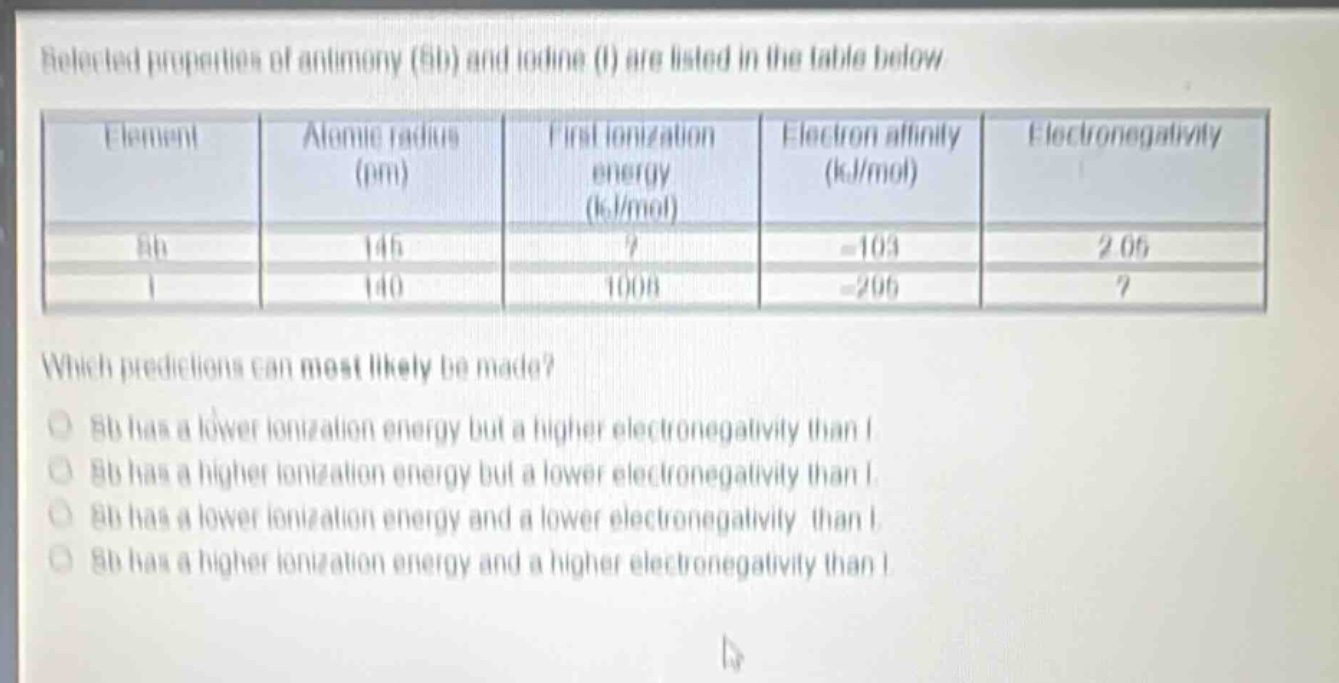
selected properties of antimony (sb) and iodine (i) are listed in the table below. which predictions can most likely be made? sb has a lower ionization energy but a higher electronegativity than i. sb has a higher ionization energy but a lower electronegativity than i. sb has a lower ionization energy and a lower electronegativity than i. sb has a higher ionization energy and a higher electronegativity than i.
Answer
Explanation:
Step1: Analyze ionization - energy trend
As we move across a period from left - to - right in the periodic table, the first ionization energy generally increases due to increasing nuclear charge and decreasing atomic radius. Antimony (Sb) is to the left of iodine (I) in the same period. So, Sb has a lower first ionization energy than I.
Step2: Analyze electronegativity trend
Electronegativity also increases across a period from left - to - right. Since Sb is to the left of I in the periodic table, Sb has a lower electronegativity than I.
Answer:
Sb has a lower ionization energy and a lower electronegativity than I.