s is a set of strings recursively defined as follows. base case: every variable from the set {a, b, c, d, e…
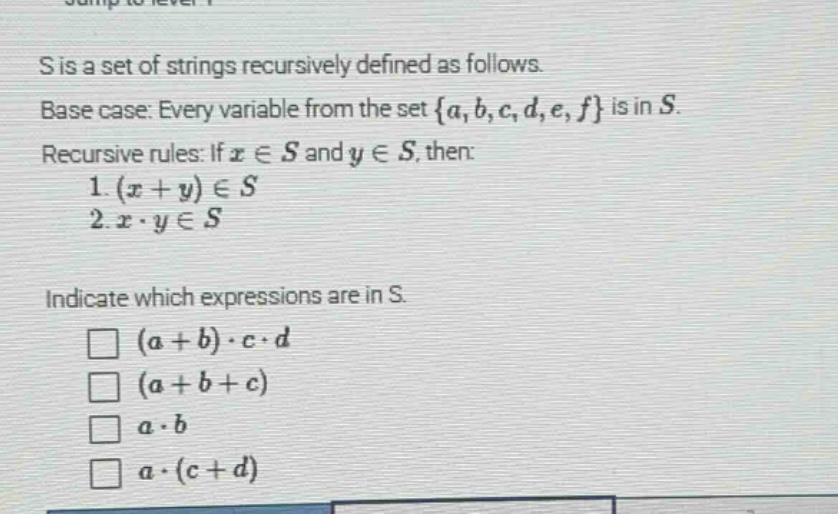
s is a set of strings recursively defined as follows. base case: every variable from the set {a, b, c, d, e, f} is in s. recursive rules: if x ∈ s and y ∈ s, then: 1. (x + y) ∈ s 2. x · y ∈ s indicate which expressions are in s. □ (a + b) · c · d □ (a + b + c) □ a · b □ a · (c + d)
Answer
Explanation:
Step1: Analyze base - case
The base - case gives that (a,b,c,d,e,f\in S).
Step2: Analyze ((a + b)\cdot c\cdot d)
Since (a,b\in S) (base - case), by recursive rule 1, ((a + b)\in S). Since (c\in S) (base - case), then by recursive rule 2, ((a + b)\cdot c\in S). Since (d\in S) (base - case), by recursive rule 2 again, ((a + b)\cdot c\cdot d\in S).
Step3: Analyze ((a + b + c))
Since (a,b\in S) (base - case), by recursive rule 1, ((a + b)\in S). Since (c\in S) (base - case), by recursive rule 1 again, ((a + b)+c=(a + b + c)\in S).
Step4: Analyze (a\cdot b)
Since (a,b\in S) (base - case), by recursive rule 2, (a\cdot b\in S).
Step5: Analyze (a\cdot(c + d))
Since (c,d\in S) (base - case), by recursive rule 1, ((c + d)\in S). Since (a\in S) (base - case), by recursive rule 2, (a\cdot(c + d)\in S).
Answer:
((a + b)\cdot c\cdot d), ((a + b + c)), (a\cdot b), (a\cdot(c + d)) are all in (S).