silver (i) nitrate ($agno_3$) reacts with copper (ii) chloride ($cucl_2$) to produce silver (i) chloride…
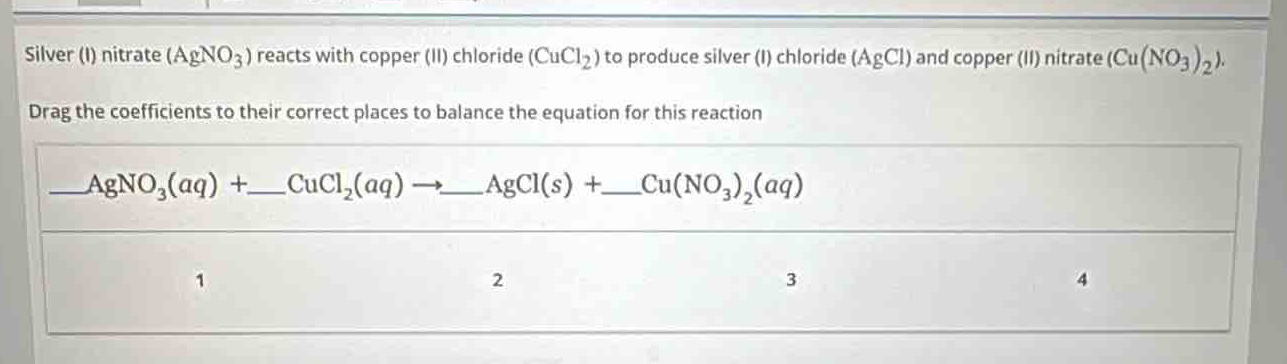
silver (i) nitrate ($agno_3$) reacts with copper (ii) chloride ($cucl_2$) to produce silver (i) chloride ($agcl$) and copper (ii) nitrate ($cu(no_3)_2$). drag the coefficients to their correct places to balance the equation for this reaction \n$\\_\\_agno_3(aq)+\\_\\_cucl_2(aq)\\rightarrow\\_\\_agcl(s)+\\_\\_cu(no_3)_2(aq)$\n1 2 3 4
Answer
Explanation:
Step1: Balance nitrate ions
There are 2 nitrate ions in $Cu(NO_3)_2$, so we need 2 moles of $AgNO_3$. So the coefficient of $AgNO_3$ is 2. $2AgNO_3(aq) + \underline{ }CuCl_2(aq)\rightarrow\underline{ }AgCl(s)+\underline{ }Cu(NO_3)_2(aq)$
Step2: Balance silver and chlorine ions
Since we have 2 moles of $AgNO_3$, we need 2 moles of $AgCl$ to balance the silver ions. And for the chlorine - copper part, 1 mole of $CuCl_2$ is sufficient as it provides 2 moles of chlorine ions which match with 2 moles of $AgCl$. $2AgNO_3(aq)+1CuCl_2(aq)\rightarrow2AgCl(s) + 1Cu(NO_3)_2(aq)$
Answer:
$2AgNO_3(aq)+1CuCl_2(aq)\rightarrow2AgCl(s) + 1Cu(NO_3)_2(aq)$