when sodium atoms (na) and chlorine atoms (cl) join to make sodium chloride, or table salt, they form an…
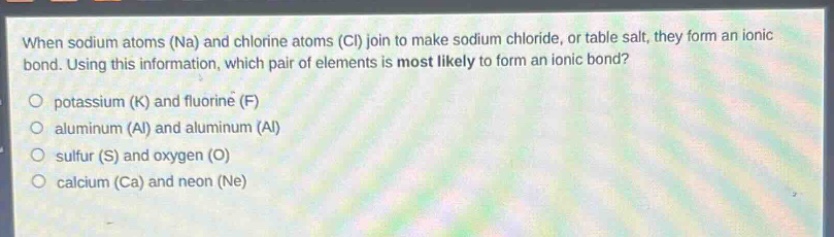
when sodium atoms (na) and chlorine atoms (cl) join to make sodium chloride, or table salt, they form an ionic bond. using this information, which pair of elements is most likely to form an ionic bond?\no potassium (k) and fluorine (f)\no aluminum (al) and aluminum (al)\no sulfur (s) and oxygen (o)\no calcium (ca) and neon (ne)
Answer
Answer:
A. potassium (K) and fluorine (F)
Explanation:
Step1: Recall ionic - bond formation
Ionic bonds form between a metal and a non - metal.
Step2: Analyze each option
- Option A: Potassium (K) is a metal and fluorine (F) is a non - metal.
- Option B: Aluminum (Al) and aluminum (Al) are the same metal, no ionic bond forms.
- Option C: Sulfur (S) and oxygen (O) are both non - metals, they form covalent bonds.
- Option D: Calcium (Ca) is a metal but neon (Ne) is a noble gas and is very stable, unlikely to form a bond.