sodium chloride is an ionic compound. the reaction below shows how sodium chloride forms from sodium and…
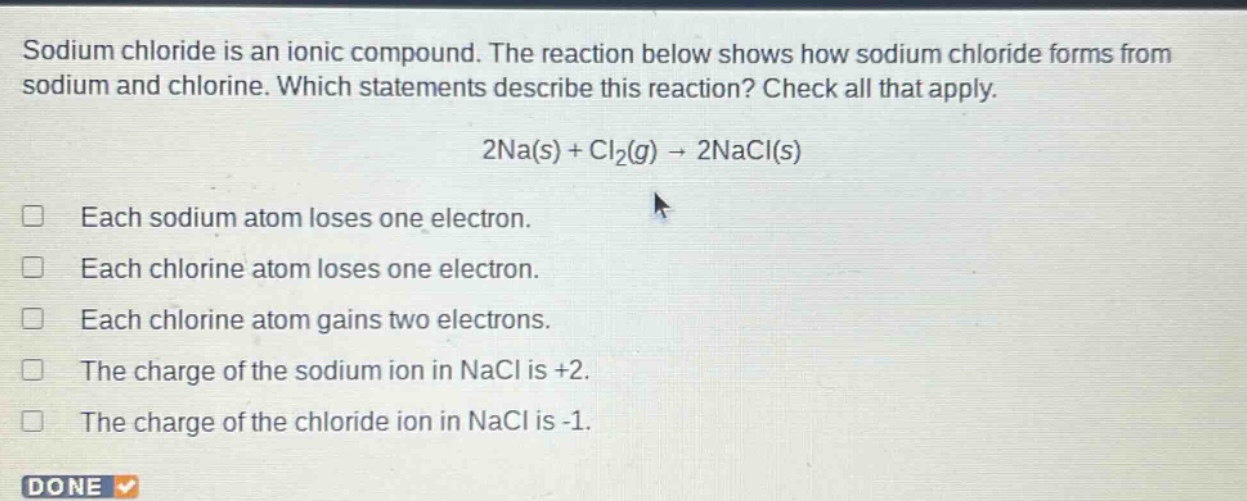
sodium chloride is an ionic compound. the reaction below shows how sodium chloride forms from sodium and chlorine. which statements describe this reaction? check all that apply. 2na(s) + cl₂(g) → 2nacl(s) each sodium atom loses one electron. each chlorine atom loses one electron. each chlorine atom gains two electrons. the charge of the sodium ion in nacl is +2. the charge of the chloride ion in nacl is -1.
Answer
Explanation:
Step1: Analyze sodium's behavior
Sodium (Na) has 1 valence - electron. In the formation of NaCl, it loses this 1 electron to achieve a stable electron - configuration. So, each sodium atom loses one electron.
Step2: Analyze chlorine's behavior
Chlorine (Cl) has 7 valence - electrons. Each chlorine atom gains 1 electron to achieve a stable octet. So, the statements about chlorine losing electrons or gaining two electrons are incorrect.
Step3: Determine ion charges
When sodium loses 1 electron, it forms a sodium ion ($Na^+$) with a charge of + 1. When chlorine gains 1 electron, it forms a chloride ion ($Cl^-$) with a charge of - 1.
Answer:
Each sodium atom loses one electron. The charge of the chloride ion in NaCl is - 1.