solubility curves\nanswer the following questions based on the solubility curve below.\n1. which salt is…
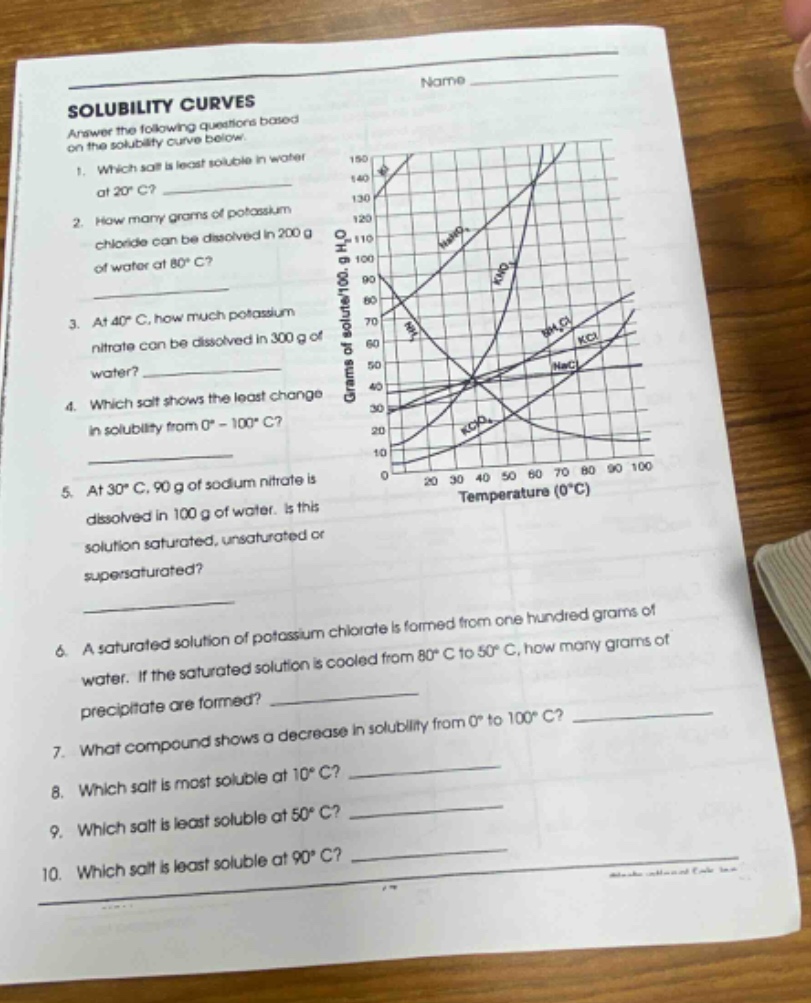
solubility curves\nanswer the following questions based on the solubility curve below.\n1. which salt is least soluble in water at 20°c?\n2. how many grams of potassium chloride can be dissolved in 200 g of water at 80°c?\n3. at 40°c, how much potassium nitrate can be dissolved in 300 g of water?\n4. which salt shows the least change in solubility from 0° - 100°c?\n5. at 30°c, 90 g of sodium nitrate is dissolved in 100 g of water. is this solution saturated, unsaturated or supersaturated?\n6. a saturated solution of potassium chlorate is formed from one hundred grams of water. if the saturated solution is cooled from 80°c to 50°c, how many grams of precipitate are formed?\n7. what compound shows a decrease in solubility from 0° to 100°c?\n8. which salt is most soluble at 10°c?\n9. which salt is least soluble at 50°c?\n10. which salt is least soluble at 90°c?
Answer
Explanation:
Step1: Locate 20°C on x - axis
Find the solubility values of salts at 20°C on the solubility - curve graph.
Step2: Compare solubilities
The salt with the lowest solubility value at 20°C is KClO₃.
Step3: For question 2, find solubility of KCl at 80°C
From the graph, solubility of KCl at 80°C is about 50 g per 100 g of water.
Step4: Calculate for 200 g of water
Since solubility is 50 g per 100 g of water, for 200 g of water, amount of KCl = 50×2 = 100 g.
Step5: For question 3, find solubility of KNO₃ at 40°C
Solubility of KNO₃ at 40°C is about 65 g per 100 g of water.
Step6: Calculate for 300 g of water
For 300 g of water, amount of KNO₃ = 65×3 = 195 g.
Step7: For question 4, observe slope of curves
NaCl shows the least change in solubility from 0°C - 100°C as its curve is the flattest.
Step8: For question 5, find solubility of NaNO₃ at 30°C
Solubility of NaNO₃ at 30°C is about 95 g per 100 g of water. Since 90 g is dissolved in 100 g of water, it is an unsaturated solution.
Step9: For question 6, find solubility of KClO₃ at 80°C and 50°C
Solubility of KClO₃ at 80°C is about 38 g per 100 g of water and at 50°C is about 18 g per 100 g of water. Precipitate = 38 - 18=20 g.
Step10: For question 7, observe curves
Ca(OH)₂ shows a decrease in solubility from 0°C to 100°C.
Step11: For question 8, find solubility at 10°C
At 10°C, KNO₃ is the most soluble.
Step12: For question 9, find solubility at 50°C
At 50°C, KClO₃ is the least soluble.
Step13: For question 10, find solubility at 90°C
At 90°C, KClO₃ is the least soluble.
Answer:
- KClO₃
- 100 g
- 195 g
- NaCl
- Unsaturated
- 20 g
- Ca(OH)₂
- KNO₃
- KClO₃
- KClO₃