the solubility of glucose at 30°c is 125 g/100 g water. a solution is made by adding 250 g of glucose to 100…
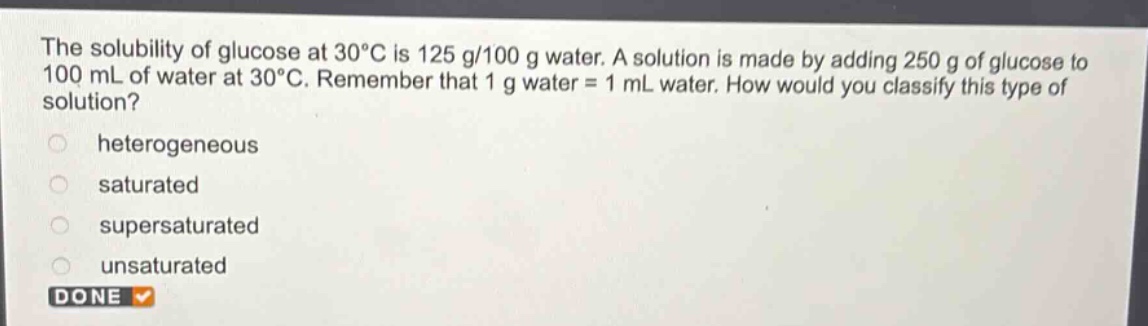
the solubility of glucose at 30°c is 125 g/100 g water. a solution is made by adding 250 g of glucose to 100 ml of water at 30°c. remember that 1 g water = 1 ml water. how would you classify this type of solution?\nheterogeneous\nsaturated\nsupersaturated\nunsaturated\ndone
Answer
Explanation:
Step1: Determine mass of water
Given 100 mL of water and 1 g water = 1 mL water, so mass of water $m_{water}=100$ g.
Step2: Find maximum amount of glucose soluble
Solubility of glucose at 30°C is 125 g/100 g water. For 100 g of water, the maximum amount of glucose that can dissolve $m_{max}=125$ g.
Step3: Compare added and maximum - soluble amounts
Amount of glucose added $m_{added}=250$ g. Since $m_{added}(250\ g)>m_{max}(125\ g)$, the solution has more solute than can dissolve under normal conditions.
Answer:
supersaturated