3. if some of the solution is drained out, what will change in a 0.70 m solution of cuso4? a. molarity will…
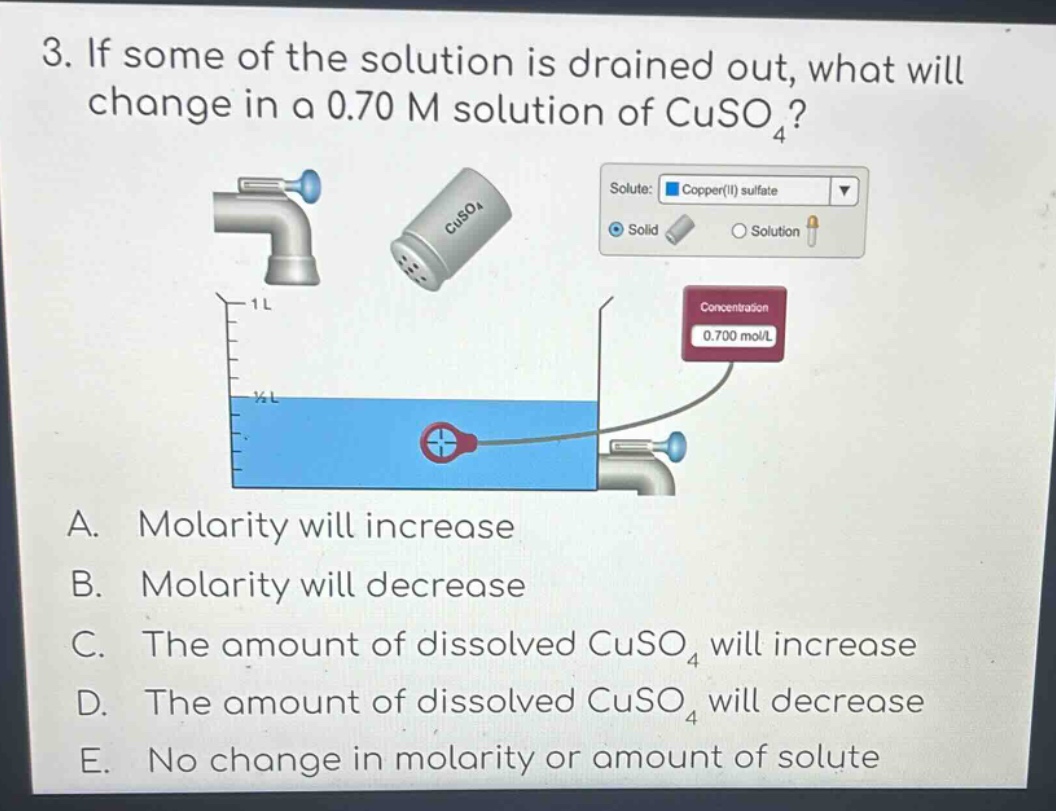
3. if some of the solution is drained out, what will change in a 0.70 m solution of cuso4? a. molarity will increase b. molarity will decrease c. the amount of dissolved cuso4 will increase d. the amount of dissolved cuso4 will decrease e. no change in molarity or amount of solute
Answer
Explanation:
Step1: Recall molarity formula
Molarity ($M$) = $\frac{n}{V}$, where $n$ is the amount of solute in moles and $V$ is the volume of the solution in liters.
Step2: Analyze effect of draining
When some of the solution is drained, both the volume $V$ of the solution and the amount of solute $n$ (number of moles of $\text{CuSO}_4$) decrease proportionally. Let the initial amount of solute be $n_1$ and initial volume be $V_1$, with molarity $M_1=\frac{n_1}{V_1} = 0.70\ M$. After draining, the new amount of solute is $n_2$ and new volume is $V_2$. Since the solution is homogeneous, $\frac{n_2}{V_2}=\frac{n_1}{V_1}$, so molarity remains the same. But the amount of dissolved $\text{CuSO}_4$ (number of moles) decreases as some of the solution is removed.
Answer:
D. The amount of dissolved $\text{CuSO}_4$ will decrease