which solution has the greatest number of hydroxide ions?\no baking soda, ph = 9\no milk, ph = 6\no tomato…
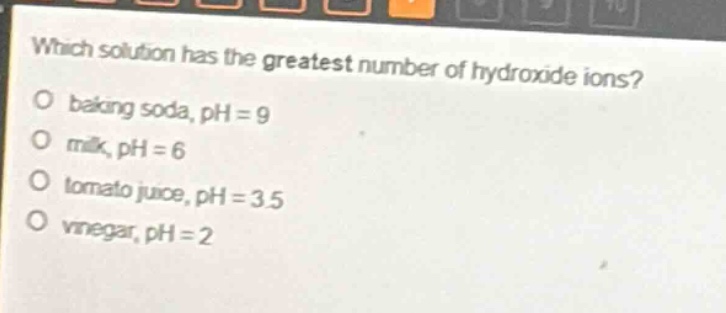
which solution has the greatest number of hydroxide ions?\no baking soda, ph = 9\no milk, ph = 6\no tomato juice, ph = 3.5\no vinegar, ph = 2
Answer
Explanation:
Step1: Recall the relationship between pH and pOH
The sum of pH and pOH is 14 at 25°C, i.e., $pH + pOH=14$. Also, $[OH^-]=10^{-pOH}$.
Step2: Calculate pOH for each solution
For baking - soda with $pH = 9$: $pOH=14 - pH=14 - 9 = 5$, and $[OH^-]=10^{-5}\ M$. For milk with $pH = 6$: $pOH=14 - pH=14 - 6 = 8$, and $[OH^-]=10^{-8}\ M$. For tomato juice with $pH = 3.5$: $pOH=14 - pH=14 - 3.5 = 10.5$, and $[OH^-]=10^{-10.5}\ M$. For vinegar with $pH = 2$: $pOH=14 - pH=14 - 2 = 12$, and $[OH^-]=10^{-12}\ M$.
Step3: Compare the $[OH^-]$ values
Since $10^{-5}>10^{-8}>10^{-10.5}>10^{-12}$, baking - soda has the highest concentration of hydroxide ions.
Answer:
baking soda, pH = 9