which could be sources of error in the lab? check all that apply.\nmeasurement of volumes when making the…
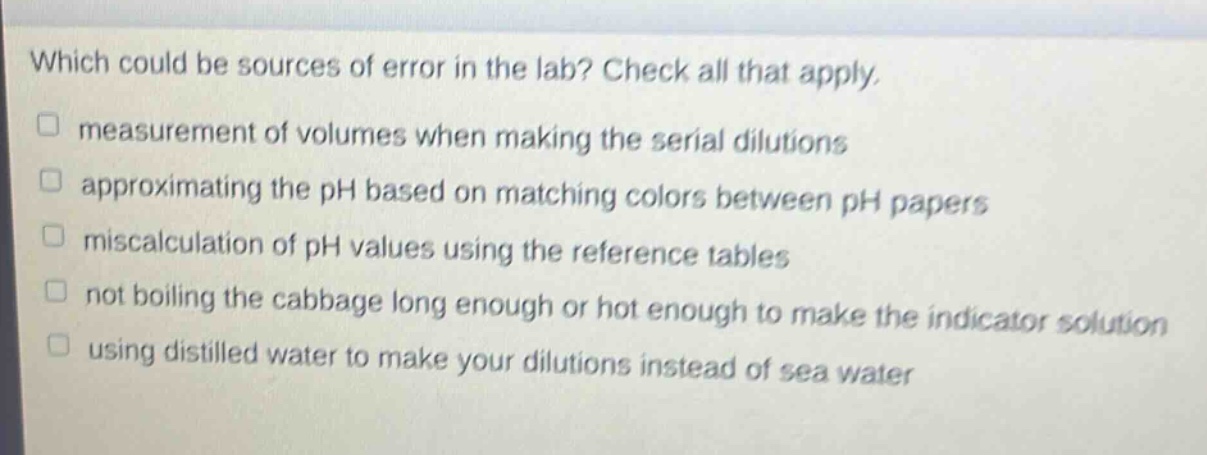
which could be sources of error in the lab? check all that apply.\nmeasurement of volumes when making the serial dilutions\napproximating the ph based on matching colors between ph papers\nmiscalculation of ph values using the reference tables\nnot boiling the cabbage long enough or hot enough to make the indicator solution\nusing distilled water to make your dilutions instead of sea water
Answer
Answer:
measurement of volumes when making the serial dilutions, approximating the pH based on matching colors between pH papers, miscalculation of pH values using the reference tables, not boiling the cabbage long enough or hot enough to make the indicator solution
Explanation:
Step1: Analyze each option
- Measurement of volumes when making the serial dilutions: Incorrect volume measurements can lead to inaccurate concentrations, which affects the results.
- Approximating the pH based on matching colors between pH papers: Visual color - matching is subjective and can introduce error.
- Miscalculation of pH values using the reference tables: Mathematical errors in calculations lead to wrong pH values.
- Not boiling the cabbage long enough or hot enough to make the indicator solution: Incomplete extraction of the indicator from the cabbage affects its performance.
- Using distilled water to make your dilutions instead of sea water: If the experiment requires sea water (e.g., to mimic a certain environment), but distilled water is used, it is a deviation from the experimental protocol. However, if the experiment is about general dilution (not specific to sea - water properties), this may not be an error. But in a typical cabbage - pH indicator lab (where the focus is on the indicator and pH measurement), using distilled water (a pure solvent for dilution) is not an error. So this option is excluded.