which statement best describes the formula equation cl₂(g) + 2kbr(aq) → 2kcl(aq)+ br₂(l)?\ncarbon iodide…
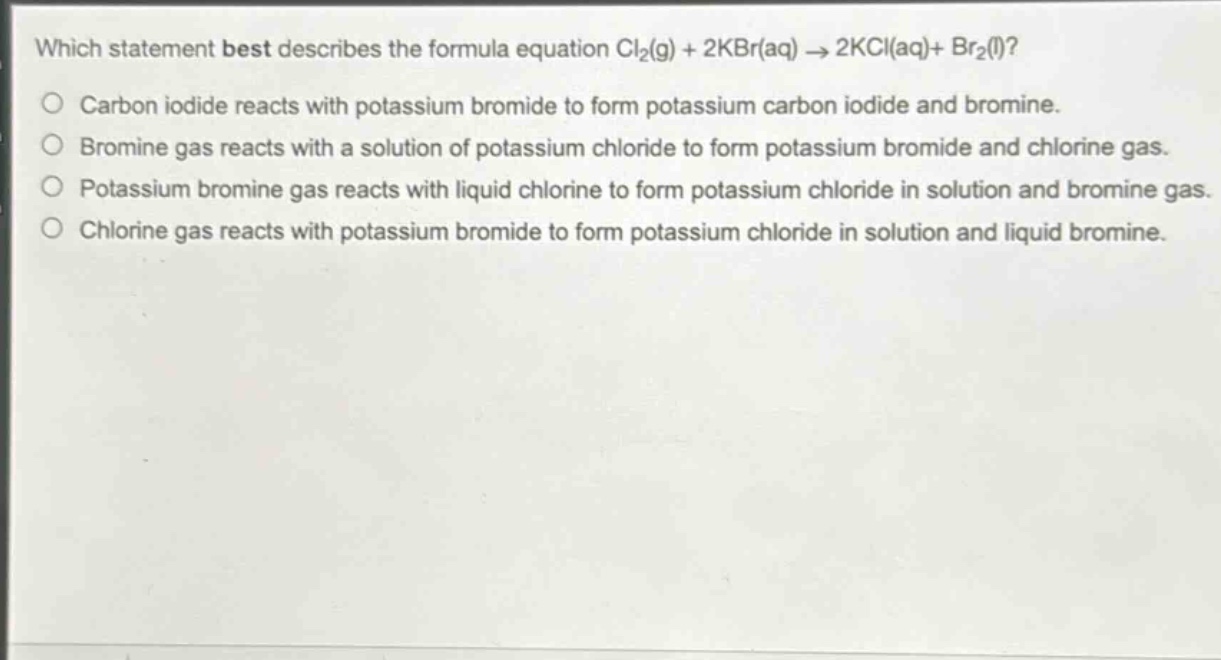
which statement best describes the formula equation cl₂(g) + 2kbr(aq) → 2kcl(aq)+ br₂(l)?\ncarbon iodide reacts with potassium bromide to form potassium carbon iodide and bromine.\nbromine gas reacts with a solution of potassium chloride to form potassium bromide and chlorine gas.\npotassium bromine gas reacts with liquid chlorine to form potassium chloride in solution and bromine gas.\nchlorine gas reacts with potassium bromide to form potassium chloride in solution and liquid bromine.
Answer
Brief Explanations:
In the equation $\mathrm{Cl}{2}(g)+2\mathrm{KBr}(aq)\rightarrow2\mathrm{KCl}(aq)+\mathrm{Br}{2}(l)$, $\mathrm{Cl}{2}$ is chlorine gas, $\mathrm{KBr}$ is potassium bromide in aqueous - solution, $\mathrm{KCl}$ is potassium chloride in aqueous - solution, and $\mathrm{Br}{2}$ is liquid bromine. So, chlorine gas reacts with potassium bromide to form potassium chloride in solution and liquid bromine.
Answer:
D. Chlorine gas reacts with potassium bromide to form potassium chloride in solution and liquid bromine.