which statement best explains why a metal atom and a nonmetal atom are most likely to form an ionic bond?\no…
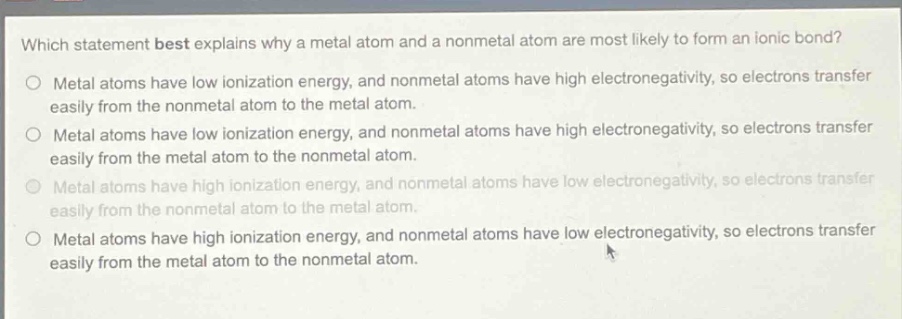
which statement best explains why a metal atom and a nonmetal atom are most likely to form an ionic bond?\no metal atoms have low ionization energy, and nonmetal atoms have high electronegativity, so electrons transfer easily from the nonmetal atom to the metal atom.\no metal atoms have low ionization energy, and nonmetal atoms have high electronegativity, so electrons transfer easily from the metal atom to the nonmetal atom.\no metal atoms have high ionization energy, and nonmetal atoms have low electronegativity, so electrons transfer easily from the nonmetal atom to the metal atom.\no metal atoms have high ionization energy, and nonmetal atoms have low electronegativity, so electrons transfer easily from the metal atom to the nonmetal atom.
Answer
Brief Explanations:
Ionization energy is the energy required to remove an electron from an atom. Metals have low ionization energy, meaning it is easy for them to lose electrons. Electronegativity is the ability of an atom to attract electrons. Non - metals have high electronegativity, meaning they can attract electrons well. In an ionic bond, electrons are transferred from the metal (which easily loses electrons due to low ionization energy) to the non - metal (which can attract electrons well due to high electronegativity).
Answer:
Metal atoms have low ionization energy, and nonmetal atoms have high electronegativity, so electrons transfer easily from the metal atom to the nonmetal atom.