which statement best explains why radon and krypton do not bond easily with other elements?\no they have…
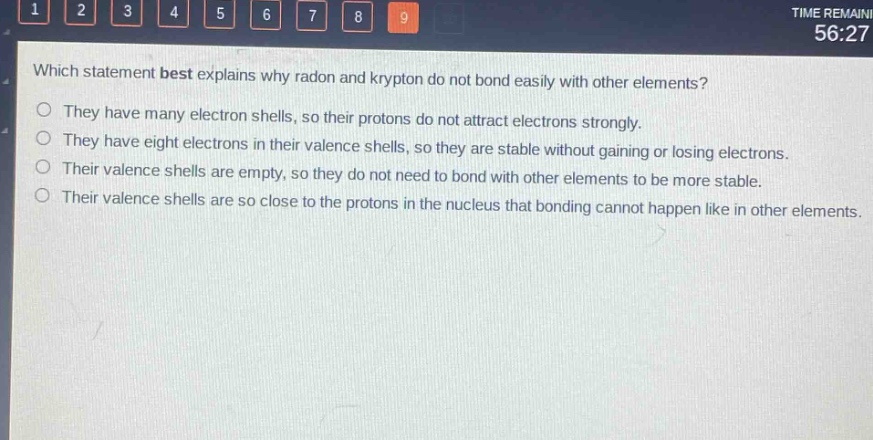
which statement best explains why radon and krypton do not bond easily with other elements?\no they have many electron shells, so their protons do not attract electrons strongly.\no they have eight electrons in their valence shells, so they are stable without gaining or losing electrons.\no their valence shells are empty, so they do not need to bond with other elements to be more stable.\no their valence shells are so close to the protons in the nucleus that bonding cannot happen like in other elements.
Answer
Brief Explanations:
Radon and krypton are noble - gases. Noble - gases have a full valence shell (8 electrons except for helium which has 2). A full valence shell makes them chemically stable and less likely to form bonds by gaining, losing, or sharing electrons.
Answer:
They have eight electrons in their valence shells, so they are stable without gaining or losing electrons.