which statement describes the arrhenius interpretation of acids and bases?\nit has a wider range of…
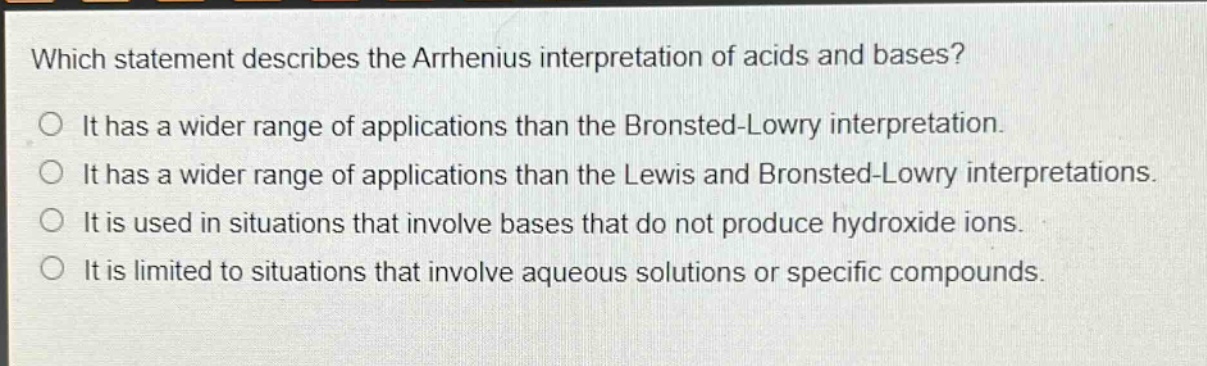
which statement describes the arrhenius interpretation of acids and bases?\nit has a wider range of applications than the bronsted - lowry interpretation.\nit has a wider range of applications than the lewis and bronsted - lowry interpretations.\nit is used in situations that involve bases that do not produce hydroxide ions.\nit is limited to situations that involve aqueous solutions or specific compounds.
Answer
Brief Explanations:
The Arrhenius theory defines acids as substances that produce hydrogen ions ($H^+$) in aqueous solution and bases as substances that produce hydroxide ions ($OH^-$) in aqueous solution. It is limited to aqueous - solution systems and specific compounds. The Brønsted - Lowry and Lewis theories have broader scopes. Brønsted - Lowry theory focuses on proton transfer and Lewis theory on electron - pair donation/acceptance. Arrhenius theory cannot handle bases that do not produce hydroxide ions in non - aqueous systems.
Answer:
It is limited to situations that involve aqueous solutions or specific compounds.