which statement about enthalpy is true?\nthe enthalpy of formation for a pure element in its standard state…
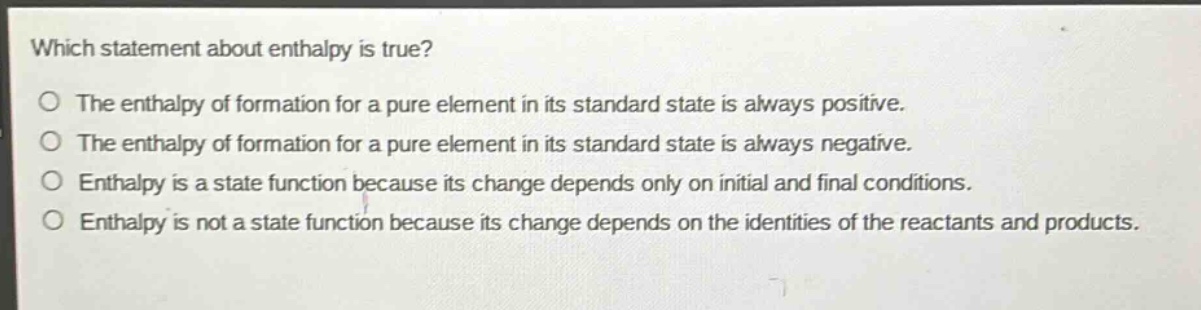
which statement about enthalpy is true?\nthe enthalpy of formation for a pure element in its standard state is always positive.\nthe enthalpy of formation for a pure element in its standard state is always negative.\nenthalpy is a state function because its change depends only on initial and final conditions.\nenthalpy is not a state function because its change depends on the identities of the reactants and products.
Answer
Answer:
Enthalpy is a state function because its change depends only on initial and final conditions.
Explanation:
Step1: Analyze enthalpy of formation for pure element in standard state
By definition, the enthalpy of formation ($\Delta H_f$) for a pure element in its standard state is (0), not positive or negative.
Step2: Recall the definition of state function
A state function is a property whose value depends only on the state of the system (initial and final conditions), not on the path taken. Enthalpy change ($\Delta H$) depends only on the initial and final states of the substances involved in a process (e.g., $\Delta H = H_{products}-H_{reactants}$), so enthalpy is a state function. The statement that it is not a state function because it depends on reactants and products is wrong as state - function property is about path - independence, not about the substances themselves.