which statement is generally true about cacl2? it has only metallic bonds between the atoms. it has only…
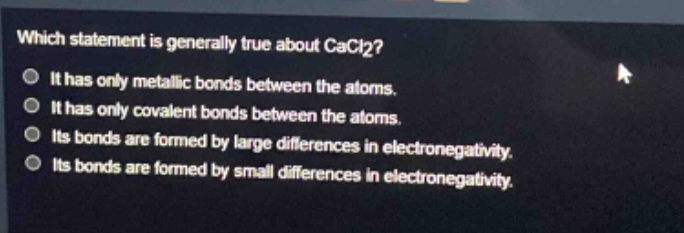
which statement is generally true about cacl2? it has only metallic bonds between the atoms. it has only covalent bonds between the atoms. its bonds are formed by large differences in electronegativity. its bonds are formed by small differences in electronegativity.
Answer
Explanation:
Step1: Identify the elements in CaCl₂
Ca (calcium) is a metal and Cl (chlorine) is a non - metal.
Step2: Recall bond - formation based on electronegativity
Ionic bonds form when there is a large difference in electronegativity between the bonding atoms. Metals have low electronegativity and non - metals have high electronegativity. In CaCl₂, calcium donates electrons to chlorine atoms, forming an ionic bond due to the large electronegativity difference.
Step3: Analyze each option
- Option 1: CaCl₂ is not a metal - metal compound, so it does not have metallic bonds.
- Option 2: Covalent bonds form between non - metals with small electronegativity differences. CaCl₂ is not a non - metal - non - metal compound, so it does not have only covalent bonds.
- Option 3: Since Ca is a metal and Cl is a non - metal, the bonds in CaCl₂ are formed by large differences in electronegativity (ionic bond). This option is correct.
- Option 4: Small differences in electronegativity lead to covalent bonds, not the type of bond in CaCl₂.