which statement is true for most chemical reactions?\nan energy change occurs during the breaking and…
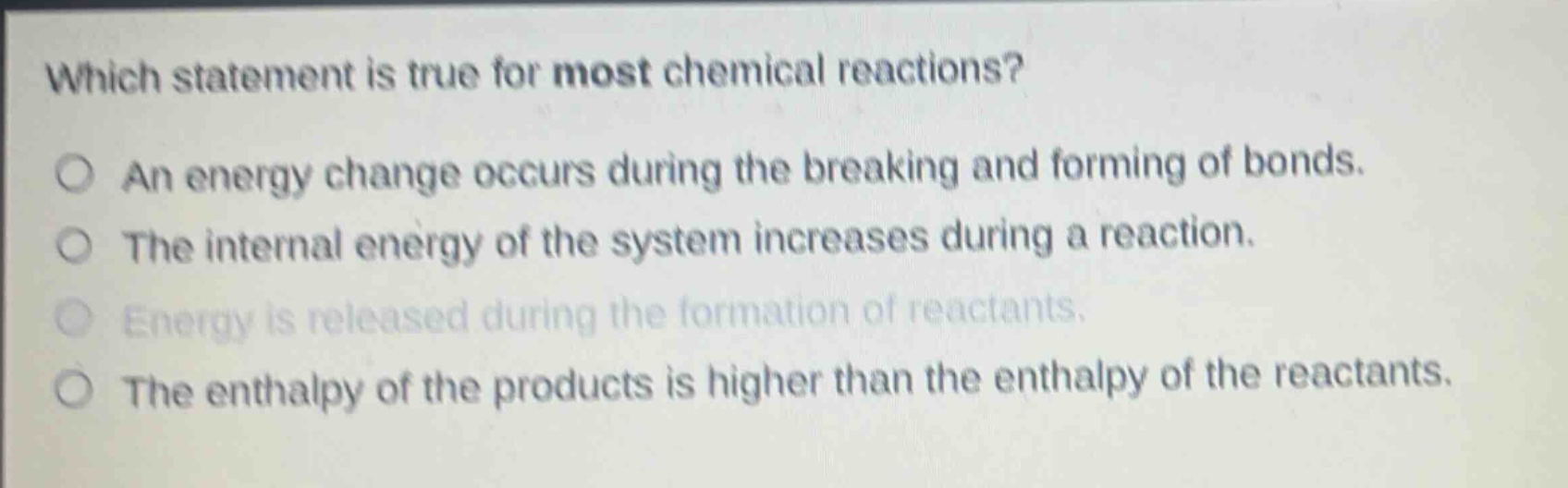
which statement is true for most chemical reactions?\nan energy change occurs during the breaking and forming of bonds.\nthe internal energy of the system increases during a reaction.\nenergy is released during the formation of reactants.\nthe enthalpy of the products is higher than the enthalpy of the reactants.
Answer
Answer:
An energy change occurs during the breaking and forming of bonds.
Explanation:
Step1: Analyze bond - breaking and forming
Breaking bonds requires energy (endothermic process), and forming bonds releases energy (exothermic process). So, an energy change occurs during these processes.
Step2: Analyze the internal energy of the system
For most reactions, the internal energy change is not always an increase. Reactions can be exothermic (internal energy of the system may decrease if heat is released to the surroundings) or endothermic (internal energy may increase if heat is absorbed from the surroundings), but it's not a universal truth for "most" reactions that internal energy increases.
Step3: Analyze energy during reactant formation
Reactants are consumed in a reaction, products are formed. Energy is released during product formation (bond - forming in products), not reactant formation.
Step4: Analyze enthalpy of products and reactants
Reactions can be exothermic ($\Delta H=\text{H}{\text{products}}-\text{H}{\text{reactants}}<0$, $\text{H}{\text{products}}<\text{H}{\text{reactants}}$) or endothermic ($\Delta H=\text{H}{\text{products}}-\text{H}{\text{reactants}}>0$, $\text{H}{\text{products}}>\text{H}{\text{reactants}}$). It's not true for most reactions that $\text{H}{\text{products}}>\text{H}{\text{reactants}}$.