which of these statements are true? select all that apply. the δhf for br2(l) is 0 kj/mol. the δhf for he(l)…
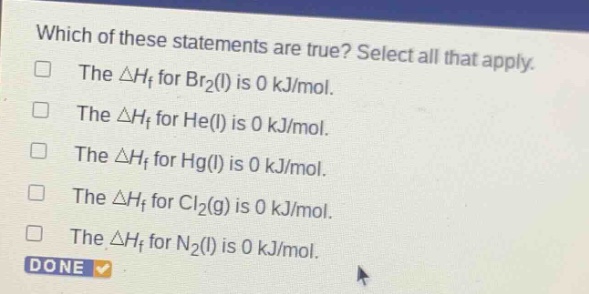
which of these statements are true? select all that apply. the δhf for br2(l) is 0 kj/mol. the δhf for he(l) is 0 kj/mol. the δhf for hg(l) is 0 kj/mol. the δhf for cl2(g) is 0 kj/mol. the δhf for n2(l) is 0 kj/mol.
Answer
Explanation:
Step1: Recall standard - state enthalpy of formation concept
The standard enthalpy of formation ($\Delta H_f$) of an element in its standard state is zero. The standard state of an element is its most stable form at 1 atm pressure and 298 K.
Step2: Analyze each substance
- $Br_2$: The standard state of bromine is $Br_2(l)$, so $\Delta H_f(Br_2(l)) = 0$ kJ/mol.
- $He$: The standard state of helium is $He(g)$, not $He(l)$, so $\Delta H_f(He(l))\neq0$ kJ/mol.
- $Hg$: The standard state of mercury is $Hg(l)$, so $\Delta H_f(Hg(l)) = 0$ kJ/mol.
- $Cl_2$: The standard state of chlorine is $Cl_2(g)$, so $\Delta H_f(Cl_2(g)) = 0$ kJ/mol.
- $N_2$: The standard state of nitrogen is $N_2(g)$, not $N_2(l)$, so $\Delta H_f(N_2(l))\neq0$ kJ/mol.
Answer:
The $\Delta H_f$ for $Br_2(l)$ is 0 kJ/mol. The $\Delta H_f$ for $Hg(l)$ is 0 kJ/mol. The $\Delta H_f$ for $Cl_2(g)$ is 0 kJ/mol.