stoichiometry practice #2\ngram to gram conversions\nuse the steps of stoichiometry to solve the following…
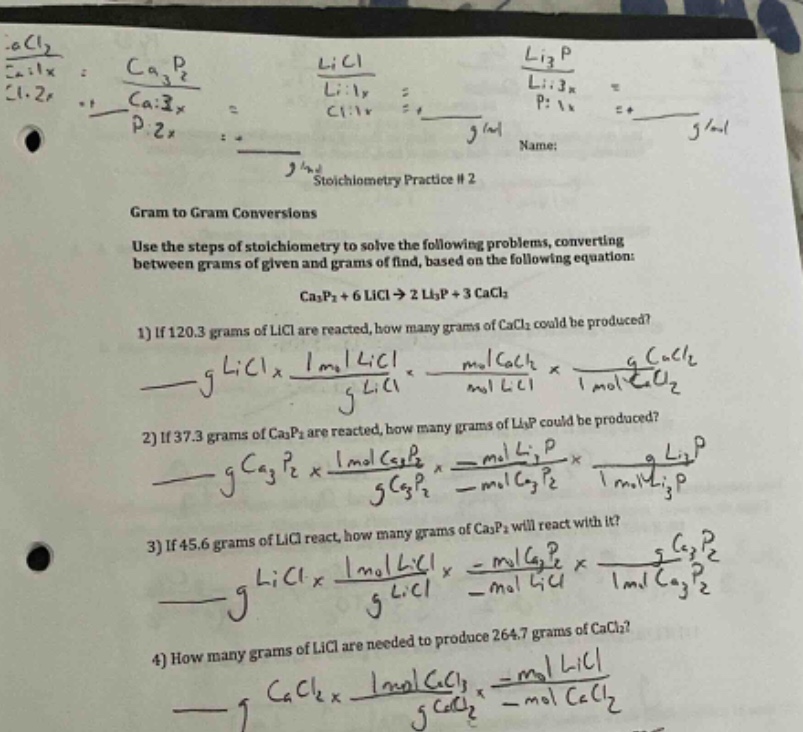
stoichiometry practice #2\ngram to gram conversions\nuse the steps of stoichiometry to solve the following problems, converting between grams of given and grams of find, based on the following equation: ca3p2 + 6 licl -> 2 li3p + 3 cacl2\n1) if 120.3 grams of licl are reacted, how many grams of cacl2 could be produced?\n2) if 37.3 grams of ca3p2 are reacted, how many grams of li3p could be produced?\n3) if 45.6 grams of licl react, how many grams of ca3p2 will react with it?\n4) how many grams of licl are needed to produce 264.7 grams of cacl2?
Answer
Explanation:
Step1: Calculate molar masses
The molar mass of $LiCl$: $M_{LiCl}=6.94 + 35.45=42.39\ g/mol$. The molar mass of $CaCl_2$: $M_{CaCl_2}=40.08+2\times35.45 = 110.98\ g/mol$. The molar mass of $Ca_3P_2$: $M_{Ca_3P_2}=3\times40.08 + 2\times30.97=120.24+61.94 = 182.18\ g/mol$. The molar mass of $Li_3P$: $M_{Li_3P}=3\times6.94+30.97 = 20.82+30.97=51.79\ g/mol$.
Step2: Solve problem 1
Given $m_{LiCl}=120.3\ g$. First, find the number of moles of $LiCl$, $n_{LiCl}=\frac{m_{LiCl}}{M_{LiCl}}=\frac{120.3\ g}{42.39\ g/mol}\approx2.84\ mol$. From the balanced - equation $Ca_3P_2 + 6LiCl\rightarrow2Li_3P+3CaCl_2$, the mole - ratio of $LiCl$ to $CaCl_2$ is $6:3 = 2:1$. So the number of moles of $CaCl_2$, $n_{CaCl_2}=\frac{1}{2}n_{LiCl}=\frac{1}{2}\times2.84\ mol = 1.42\ mol$. Then the mass of $CaCl_2$, $m_{CaCl_2}=n_{CaCl_2}\times M_{CaCl_2}=1.42\ mol\times110.98\ g/mol\approx157.6\ g$.
Step3: Solve problem 2
Given $m_{Ca_3P_2}=37.3\ g$. The number of moles of $Ca_3P_2$, $n_{Ca_3P_2}=\frac{m_{Ca_3P_2}}{M_{Ca_3P_2}}=\frac{37.3\ g}{182.18\ g/mol}\approx0.205\ mol$. From the balanced - equation, the mole - ratio of $Ca_3P_2$ to $Li_3P$ is $1:2$. So the number of moles of $Li_3P$, $n_{Li_3P}=2n_{Ca_3P_2}=2\times0.205\ mol = 0.41\ mol$. Then the mass of $Li_3P$, $m_{Li_3P}=n_{Li_3P}\times M_{Li_3P}=0.41\ mol\times51.79\ g/mol\approx21.2\ g$.
Step4: Solve problem 3
Given $m_{LiCl}=45.6\ g$. The number of moles of $LiCl$, $n_{LiCl}=\frac{m_{LiCl}}{M_{LiCl}}=\frac{45.6\ g}{42.39\ g/mol}\approx1.08\ mol$. From the balanced - equation, the mole - ratio of $LiCl$ to $Ca_3P_2$ is $6:1$. So the number of moles of $Ca_3P_2$, $n_{Ca_3P_2}=\frac{1}{6}n_{LiCl}=\frac{1}{6}\times1.08\ mol = 0.18\ mol$. Then the mass of $Ca_3P_2$, $m_{Ca_3P_2}=n_{Ca_3P_2}\times M_{Ca_3P_2}=0.18\ mol\times182.18\ g/mol\approx32.8\ g$.
Step5: Solve problem 4
Given $m_{CaCl_2}=264.7\ g$. The number of moles of $CaCl_2$, $n_{CaCl_2}=\frac{m_{CaCl_2}}{M_{CaCl_2}}=\frac{264.7\ g}{110.98\ g/mol}\approx2.39\ mol$. From the balanced - equation, the mole - ratio of $LiCl$ to $CaCl_2$ is $6:3 = 2:1$. So the number of moles of $LiCl$, $n_{LiCl}=2n_{CaCl_2}=2\times2.39\ mol = 4.78\ mol$. Then the mass of $LiCl$, $m_{LiCl}=n_{LiCl}\times M_{LiCl}=4.78\ mol\times42.39\ g/mol\approx202.6\ g$.
Answer:
- Approximately $157.6\ g$ of $CaCl_2$ could be produced.
- Approximately $21.2\ g$ of $Li_3P$ could be produced.
- Approximately $32.8\ g$ of $Ca_3P_2$ will react with it.
- Approximately $202.6\ g$ of $LiCl$ are needed.