a student is asked to balance an equation by using the half - reaction method. he determines the two half…
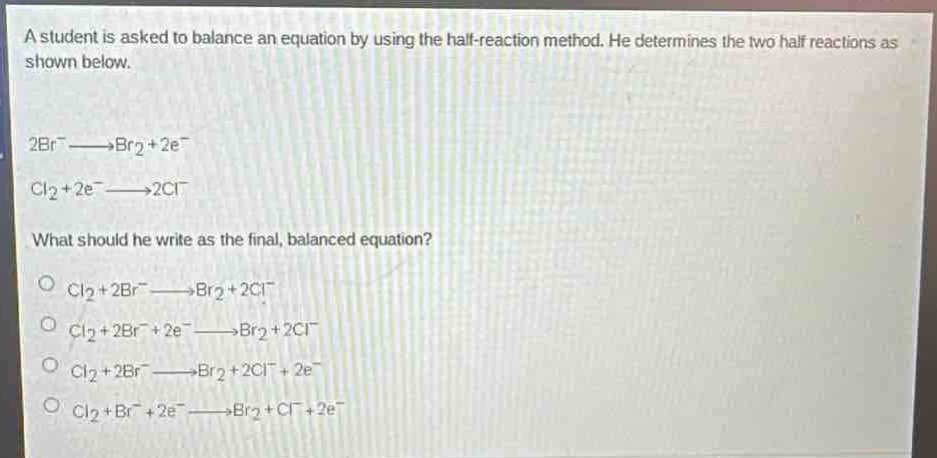
a student is asked to balance an equation by using the half - reaction method. he determines the two half reactions as shown below.\n2br⁻→br₂ + 2e⁻\ncl₂+2e⁻→2cl⁻\nwhat should he write as the final, balanced equation?\ncl₂ + 2br⁻→br₂ + 2cl⁻\ncl₂ + 2br⁻+2e⁻→br₂ + 2cl⁻\ncl₂ + 2br⁻→br₂ + 2cl⁻+2e⁻\ncl₂ + br⁻+2e⁻→br₂ + cl⁻+2e⁻
Answer
Explanation:
Step1: Identify the oxidation and reduction half - reactions
The first reaction $2Br^-\longrightarrow Br_2 + 2e^-$ is an oxidation half - reaction (loss of electrons), and the second reaction $Cl_2+2e^-\longrightarrow 2Cl^-$ is a reduction half - reaction (gain of electrons).
Step2: Combine the half - reactions
Since the number of electrons in both half - reactions is the same (2 electrons), we can directly add the two half - reactions together. $2Br^-\longrightarrow Br_2 + 2e^-$ $Cl_2+2e^-\longrightarrow 2Cl^-$ Adding them gives $Cl_2 + 2Br^-\longrightarrow Br_2+2Cl^-$
Answer:
$Cl_2 + 2Br^-\longrightarrow Br_2+2Cl^-$