a student makes a saturated sugar solution by dissolving sugar grains in warm water, stirring, and adding…
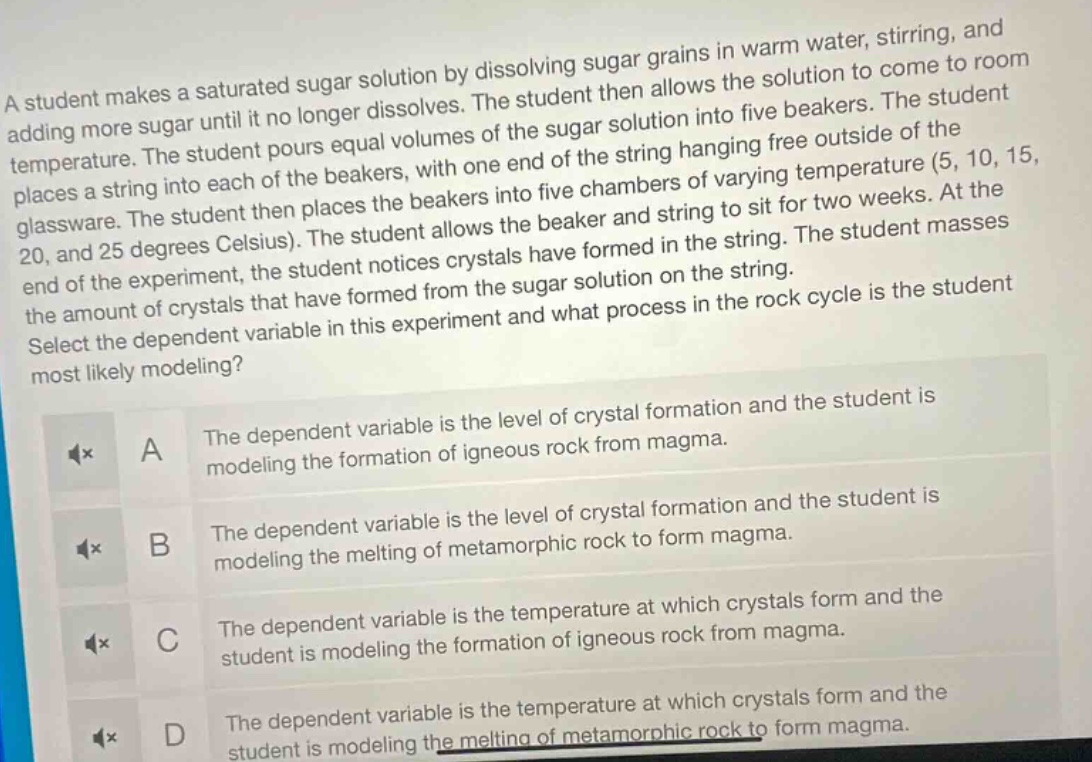
a student makes a saturated sugar solution by dissolving sugar grains in warm water, stirring, and adding more sugar until it no longer dissolves. the student then allows the solution to come to room temperature. the student pours equal volumes of the sugar solution into five beakers. the student places a string into each of the beakers, with one end of the string hanging free outside of the glassware. the student then places the beakers into five chambers of varying temperature (5, 10, 15, 20, and 25 degrees celsius). the student allows the beaker and string to sit for two weeks. at the end of the experiment, the student notices crystals have formed in the string. the student masses the amount of crystals that have formed from the sugar solution on the string. select the dependent variable in this experiment and what process in the rock cycle is the student most likely modeling? a the dependent variable is the level of crystal formation and the student is modeling the formation of igneous rock from magma. b the dependent variable is the level of crystal formation and the student is modeling the melting of metamorphic rock to form magma. c the dependent variable is the temperature at which crystals form and the student is modeling the formation of igneous rock from magma. d the dependent variable is the temperature at which crystals form and the student is modeling the melting of metamorphic rock to form magma.
Answer
Brief Explanations:
The dependent variable is what is being measured and is affected by the independent variable. Here, the amount of crystals formed is what the student is measuring, so it's the dependent variable. The process of crystals forming from a solution is similar to the formation of sedimentary rock through precipitation, but among the given options related to the rock - cycle, the formation of crystals from a solution is somewhat analogous to the cooling and solidification process in the rock - cycle which is related to the formation of igneous rock from magma. The student is changing the temperature (independent variable) and observing the crystal formation (dependent variable).
Answer:
A. The dependent variable is the level of crystal formation and the student is modeling the formation of igneous rock from magma.