students are completing a table about a particular subatomic particle that helps make up an atom. the…
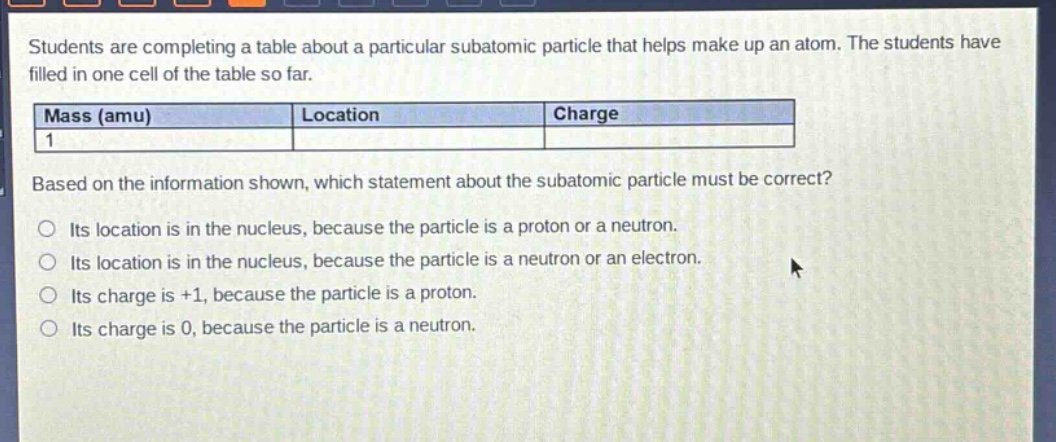
students are completing a table about a particular subatomic particle that helps make up an atom. the students have filled in one cell of the table so far.\n| mass (amu) | location | charge |\n| ---- | ---- | ---- |\n| 1 | | |\nbased on the information shown, which statement about the subatomic particle must be correct?\no its location is in the nucleus, because the particle is a proton or a neutron.\no its location is in the nucleus, because the particle is a neutron or an electron.\no its charge is +1, because the particle is a proton.\no its charge is 0, because the particle is a neutron.
Answer
Brief Explanations:
Protons and neutrons have a mass of approximately 1 amu. Protons have a charge of + 1 and neutrons have a charge of 0. Both protons and neutrons are located in the nucleus, while electrons have a very small mass (about $\frac{1}{1836}$ amu) and are located outside the nucleus. Given a mass of 1 amu, the particle could be a proton or a neutron, so it must be in the nucleus.
Answer:
Its location is in the nucleus, because the particle is a proton or a neutron.