students are completing a table about a particular subatomic particle that helps make up an atom.\n| mass…
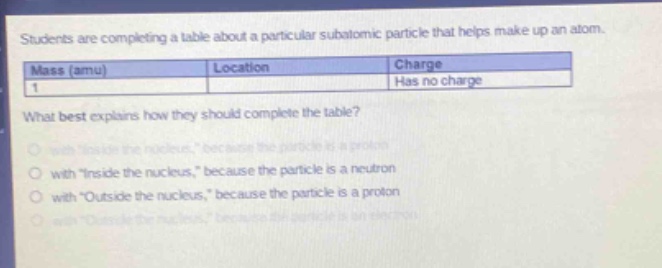
students are completing a table about a particular subatomic particle that helps make up an atom.\n| mass (amu) | location | charge |\n| ---- | ---- | ---- |\n| 1 | | has no charge |\nwhat best explains how they should complete the table?\n- with \inside the nucleus,\ because the particle is a proton\n- with \inside the nucleus,\ because the particle is a neutron\n- with \outside the nucleus,\ because the particle is a proton\n- with \outside the nucleus,\ because the particle is an electron
Answer
Brief Explanation:
Protons have a mass of 1 amu and a positive charge. Neutrons have a mass of 1 amu and no charge and are located inside the nucleus. Electrons have a very small mass and a negative charge and are outside the nucleus. Since the particle has a mass of 1 amu and no charge, it is a neutron and is inside the nucleus.
Answer:
with "inside the nucleus," because the particle is a neutron