sulfur oxides and nitrogen oxides are pollutants that are produced when fossil fuels are burned. sulfur…
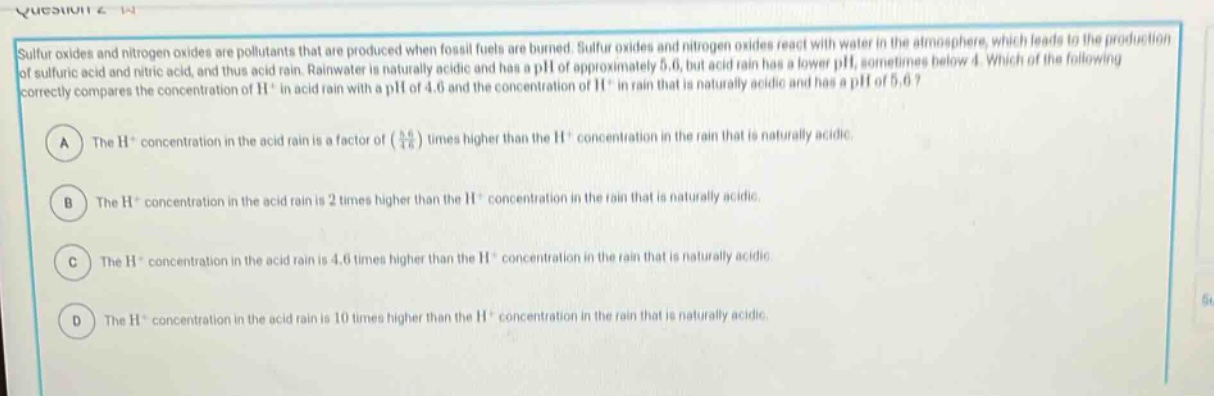
sulfur oxides and nitrogen oxides are pollutants that are produced when fossil fuels are burned. sulfur oxides and nitrogen oxides react with water in the atmosphere, which leads to the production of sulfuric acid and nitric acid, and thus acid rain. rainwater is naturally acidic and has a ph of approximately 5.6, but acid rain has a lower ph, sometimes below 4. which of the following correctly compares the concentration of h⁺ in acid rain with a ph of 4.6 and the concentration of h⁺ in rain that is naturally acidic and has a ph of 5.6?\na the h⁺ concentration in the acid rain is a factor of (\\frac{5.6}{4.6}) times higher than the h⁺ concentration in the rain that is naturally acidic.\nb the h⁺ concentration in the acid rain is 2 times higher than the h⁺ concentration in the rain that is naturally acidic.\nc the h⁺ concentration in the acid rain is 4.6 times higher than the h⁺ concentration in the rain that is naturally acidic.\nd the h⁺ concentration in the acid rain is 10 times higher than the h⁺ concentration in the rain that is naturally acidic.
Answer
Explanation:
Step1: Recall pH formula
The formula for pH is $pH = -\log[H^+]$, so $[H^+]=10^{-pH}$.
Step2: Calculate $[H^+]$ for pH = 4.6
For acid - rain with pH = 4.6, $[H^+]_1 = 10^{-4.6}$.
Step3: Calculate $[H^+]$ for pH = 5.6
For naturally - acidic rain with pH = 5.6, $[H^+]_2=10^{-5.6}$.
Step4: Find the ratio of the two concentrations
$\frac{[H^+]_1}{[H^+]_2}=\frac{10^{-4.6}}{10^{-5.6}}$. Using the rule of exponents $\frac{a^m}{a^n}=a^{m - n}$, we have $\frac{10^{-4.6}}{10^{-5.6}}=10^{-4.6-(-5.6)} = 10^{(-4.6 + 5.6)}=10^1 = 10$.
Answer:
D. The $H^+$ concentration in the acid rain is 10 times higher than the $H^+$ concentration in the rain that is naturally acidic.