sulfur reacts with oxygen to form sulfur dioxide (so₂(g), δhf = -296.8 kj/mol) according to the equation…
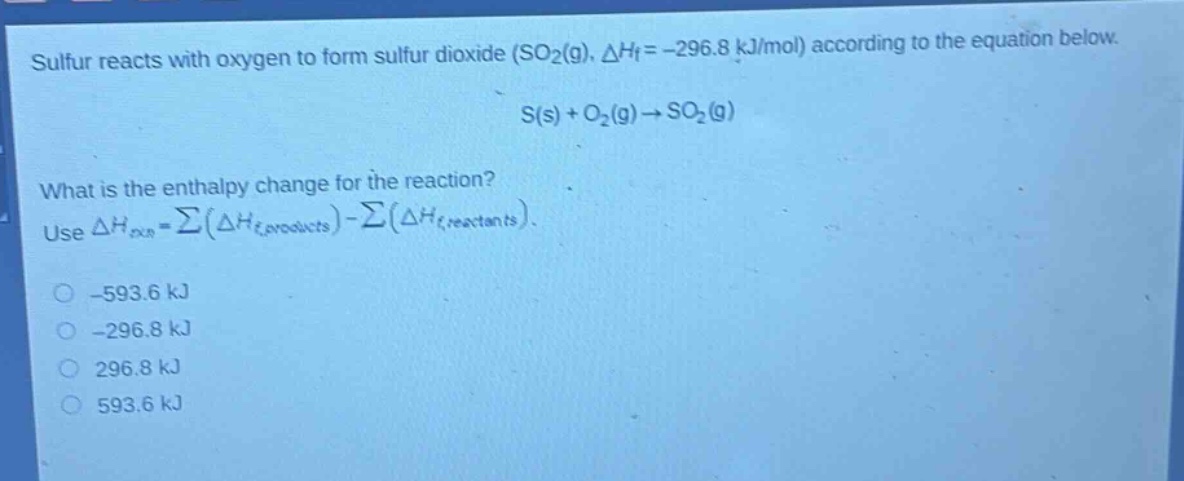
sulfur reacts with oxygen to form sulfur dioxide (so₂(g), δhf = -296.8 kj/mol) according to the equation below.\ns(s) + o₂(g) → so₂(g)\nwhat is the enthalpy change for the reaction?\nuse δhrxn = σ(δhf,products) - σ(δhf,reactants).\n-593.6 kj\n-296.8 kj\n296.8 kj\n593.6 kj
Answer
Explanation:
Step1: Identify reactants and products
Reactants: S(s), O₂(g); Product: SO₂(g)
Step2: Determine enthalpy of formation values
For S(s) and O₂(g), $\Delta H_f = 0$ kJ/mol (standard state elements). For SO₂(g), $\Delta H_f=- 296.8$ kJ/mol.
Step3: Apply the enthalpy - change formula
$\Delta H_{rxn}=\sum(\Delta H_{f,products})-\sum(\Delta H_{f,reactants})$. $\sum(\Delta H_{f,products})=-296.8$ kJ/mol (since there is 1 mole of SO₂). $\sum(\Delta H_{f,reactants}) = 0+0 = 0$ kJ/mol. So, $\Delta H_{rxn}=-296.8 - 0=-296.8$ kJ/mol.
Answer:
-296.8 kJ