sulfur trioxide can be formed from sulfur dioxide and oxygen using the given set equations. what is the…
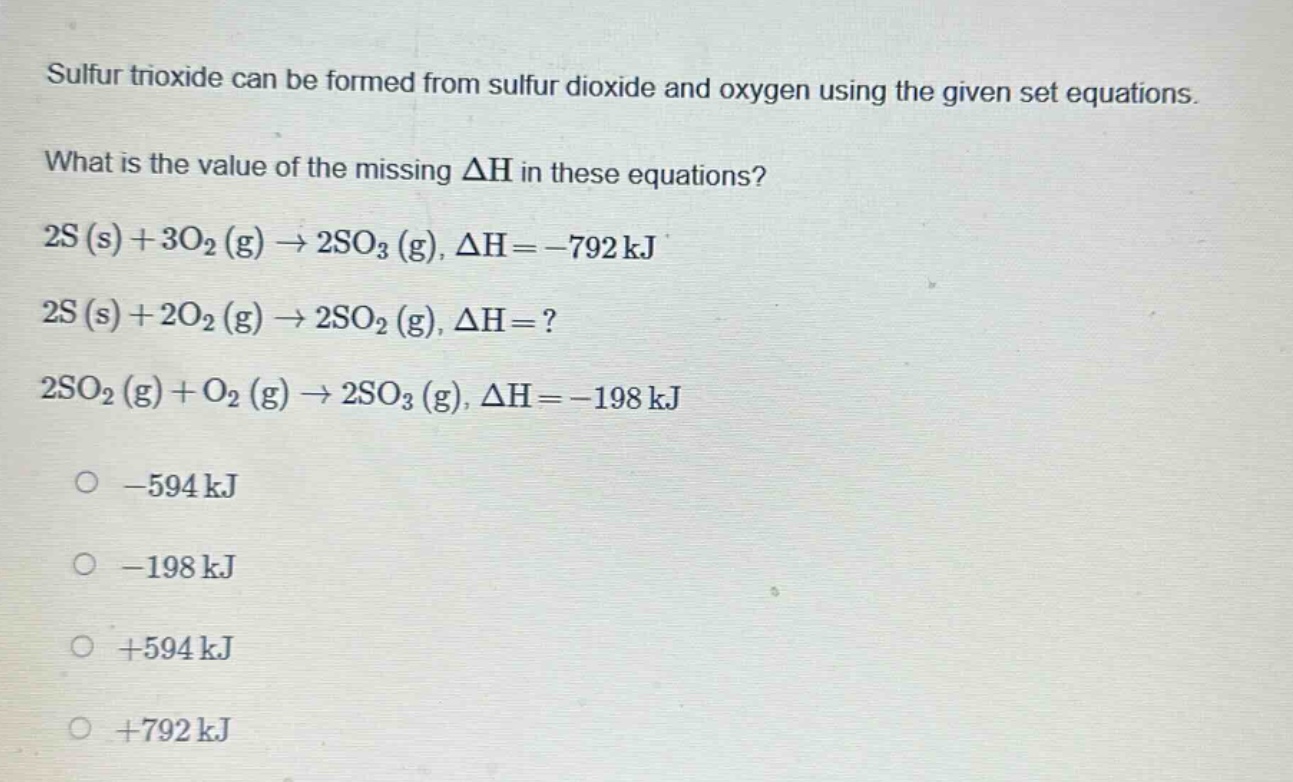
sulfur trioxide can be formed from sulfur dioxide and oxygen using the given set equations. what is the value of the missing δh in these equations? 2s (s) + 3o2 (g) → 2so3 (g), δh = -792 kj 2s (s) + 2o2 (g) → 2so2 (g), δh =? 2so2 (g) + o2 (g) → 2so3 (g), δh = -198 kj -594 kj -198 kj +594 kj +792 kj
Answer
Explanation:
Step1: Label the equations
Let (2S(s)+3O_2(g)\rightarrow2SO_3(g), \Delta H_1 = - 792\ kJ) be Equation 1, (2S(s)+2O_2(g)\rightarrow2SO_2(g), \Delta H_2=?) be Equation 2, and (2SO_2(g)+O_2(g)\rightarrow2SO_3(g), \Delta H_3=-198\ kJ) be Equation 3.
Step2: Use Hess's law
According to Hess's law, Equation 1 can be considered as the sum of Equation 2 and Equation 3. That is (\Delta H_1=\Delta H_2+\Delta H_3).
Step3: Solve for (\Delta H_2)
Rearrange the formula (\Delta H_2=\Delta H_1 - \Delta H_3). Substitute (\Delta H_1=-792\ kJ) and (\Delta H_3 = - 198\ kJ) into the formula: (\Delta H_2=-792-(-198)=-792 + 198=-594\ kJ).
Answer:
-594 kJ