suna passes an electric current through a sample of clear, colorless, and odorless liquid. as the experiment…
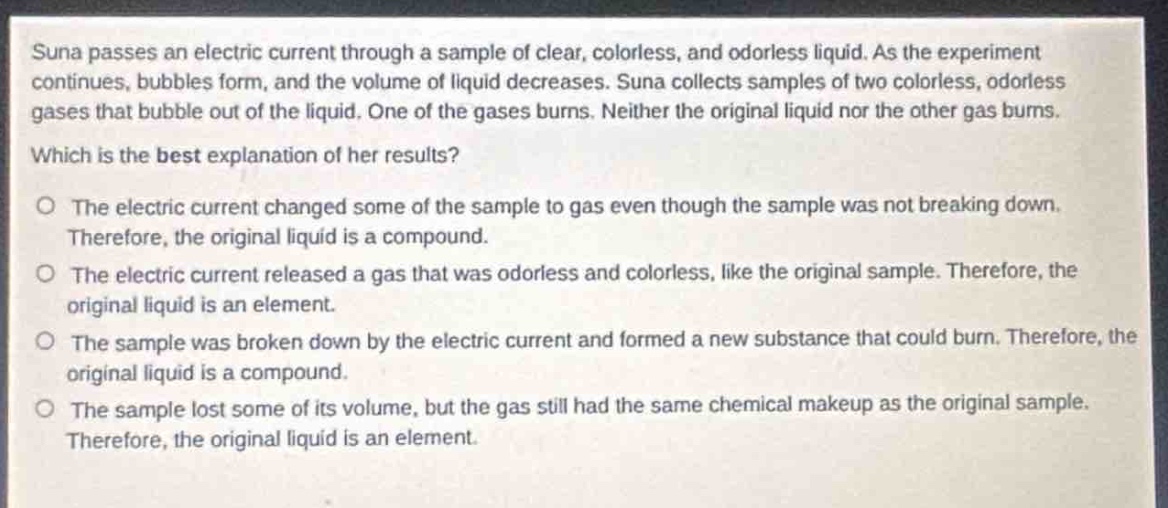
suna passes an electric current through a sample of clear, colorless, and odorless liquid. as the experiment continues, bubbles form, and the volume of liquid decreases. suna collects samples of two colorless, odorless gases that bubble out of the liquid. one of the gases burns. neither the original liquid nor the other gas burns. which is the best explanation of her results? o the electric current changed some of the sample to gas even though the sample was not breaking down. therefore, the original liquid is a compound. o the electric current released a gas that was odorless and colorless, like the original sample. therefore, the original liquid is an element. o the sample was broken down by the electric current and formed a new substance that could burn. therefore, the original liquid is a compound. o the sample lost some of its volume, but the gas still had the same chemical makeup as the original sample. therefore, the original liquid is an element.
Answer
Brief Explanations:
When an electric current breaks down a substance into different substances (in this case, a liquid is broken down into two gases with different properties, one of which burns), it indicates a chemical change. Compounds can be decomposed into simpler substances through chemical reactions like electrolysis. Elements cannot be broken down into simpler substances by ordinary chemical means. Since the liquid was broken down into new substances by the electric - current, it is a compound.
Answer:
The sample was broken down by the electric current and formed a new substance that could burn. Therefore, the original liquid is a compound.