suppose that a student did not stop the timer as soon as bubbling stopped during a test at 40°c. check all…
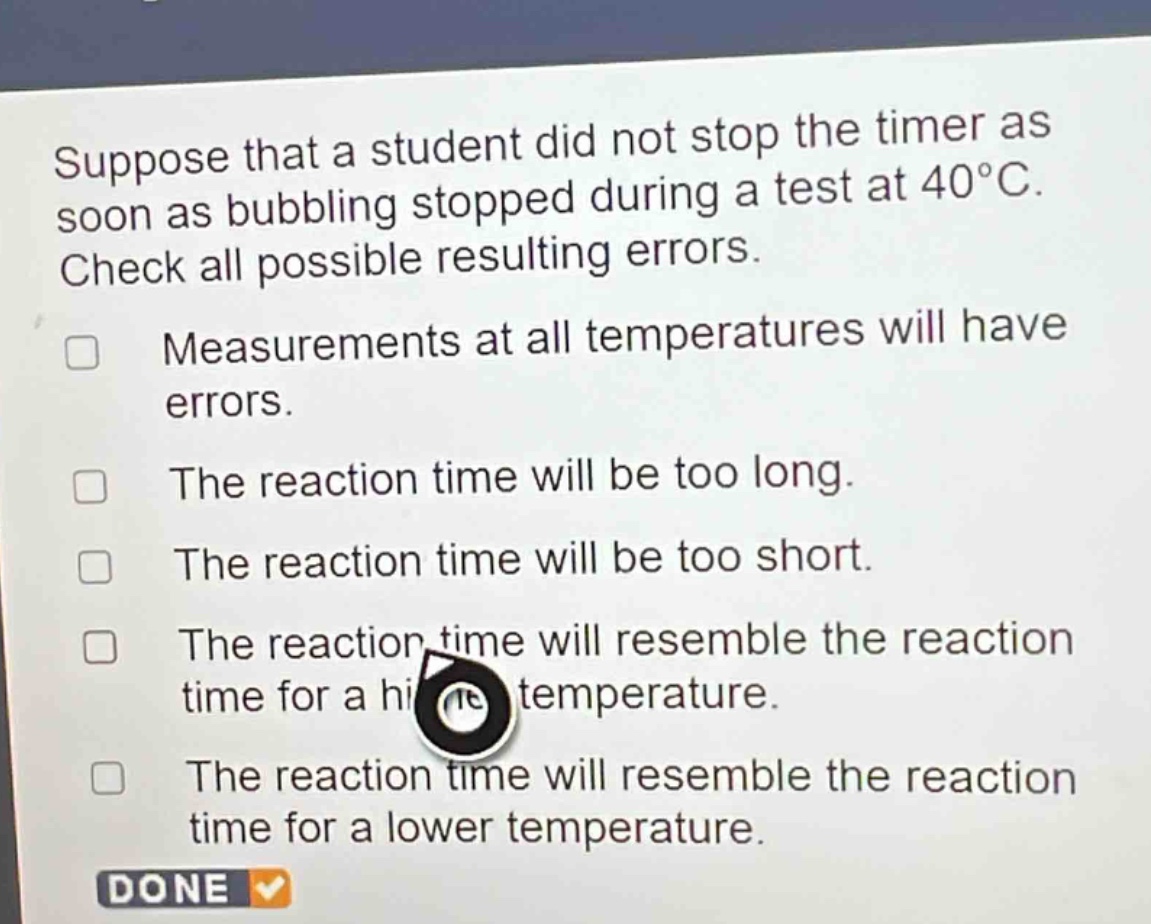
suppose that a student did not stop the timer as soon as bubbling stopped during a test at 40°c. check all possible resulting errors.\nmeasurements at all temperatures will have errors.\nthe reaction time will be too long.\nthe reaction time will be too short.\nthe reaction time will resemble the reaction time for a higher temperature.\nthe reaction time will resemble the reaction time for a lower temperature.
Answer
Brief Explanations:
If the student didn't stop the timer as soon as bubbling stopped, more time is recorded than the actual reaction time. This makes the measured reaction time too long. Also, since the recorded time is inflated, it may seem like the reaction took as long as it would at a lower - temperature (where reactions are generally slower). Measurements at all temperatures won't necessarily have errors just because of this one - time error at 40°C. And the reaction time won't be too short.
Answer:
The reaction time will be too long. The reaction time will resemble the reaction time for a lower temperature.