suzys science class is studying changes in particle motion during phase changes. suzy is asked to add a few…
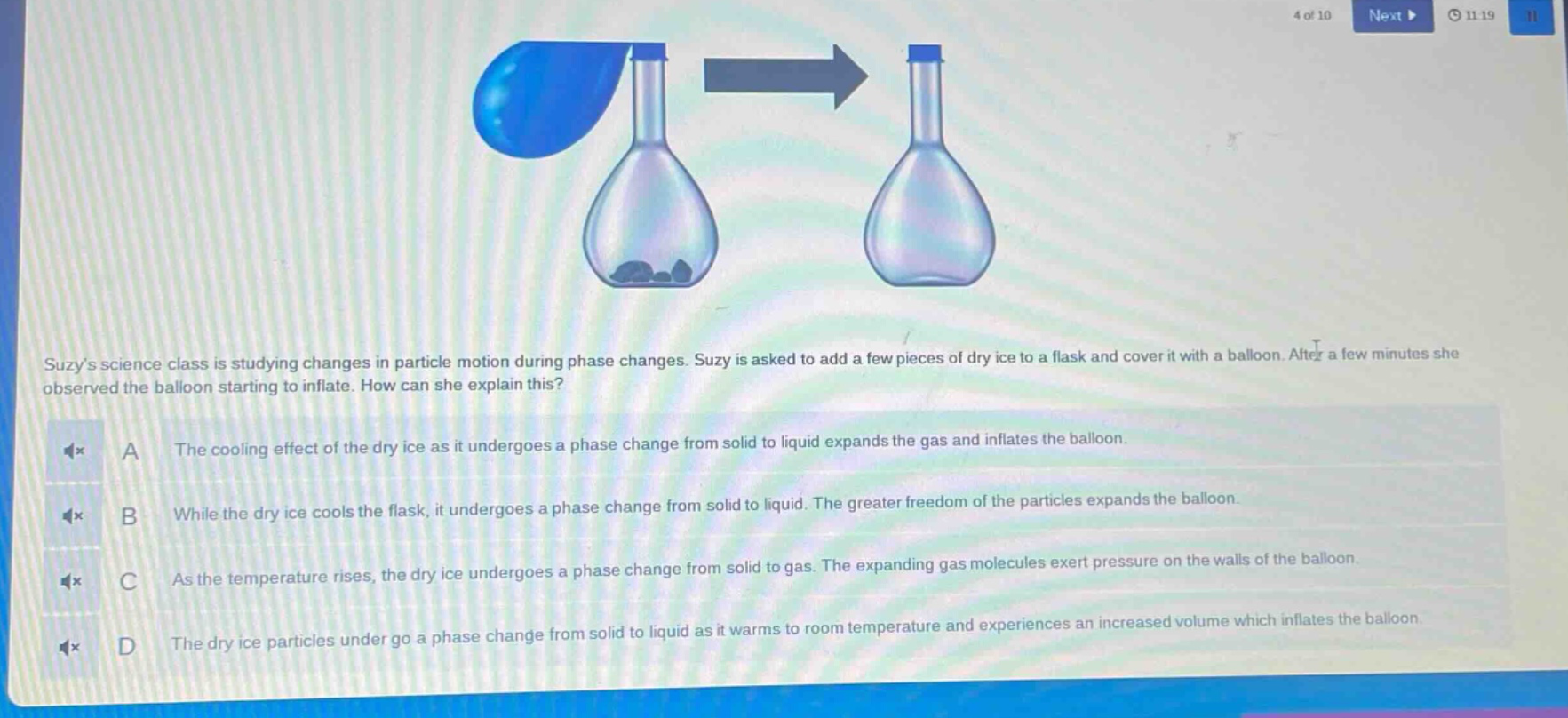
suzys science class is studying changes in particle motion during phase changes. suzy is asked to add a few pieces of dry ice to a flask and cover it with a balloon. after a few minutes she observed the balloon starting to inflate. how can she explain this? a the cooling effect of the dry ice as it undergoes a phase change from solid to liquid expands the gas and inflates the balloon. b while the dry ice cools the flask, it undergoes a phase change from solid to liquid. the greater freedom of the particles expands the balloon. c as the temperature rises, the dry ice undergoes a phase change from solid to gas. the expanding gas molecules exert pressure on the walls of the balloon. d the dry ice particles under go a phase change from solid to liquid as it warms to room temperature and experiences an increased volume which inflates the balloon.
Answer
Brief Explanations:
Dry - ice is solid carbon - dioxide which sublimates (changes directly from solid to gas) at room temperature. As it changes to gas, the gas molecules expand and exert pressure on the balloon walls causing it to inflate. Options A, B, and D are incorrect because dry - ice does not melt to a liquid at room temperature; it sublimates to a gas.
Answer:
C. As the temperature rises, the dry ice undergoes a phase change from solid to gas. The expanding gas molecules exert pressure on the walls of the balloon.