the synthesis reaction to form boron hydride is: 2b(s) + 3h₂(g) → b₂h₆(g), δh = +36 kj. what is the enthalpy…
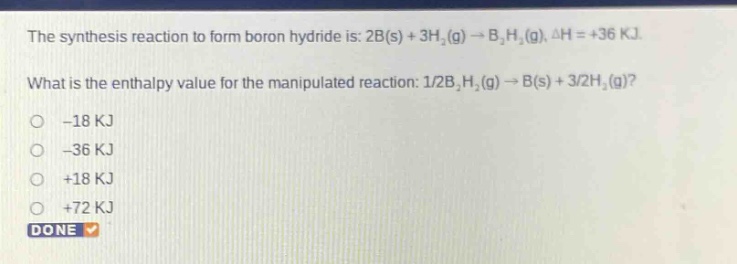
the synthesis reaction to form boron hydride is: 2b(s) + 3h₂(g) → b₂h₆(g), δh = +36 kj. what is the enthalpy value for the manipulated reaction: 1/2b₂h₆(g) → b(s) + 3/2h₂(g)? -18 kj -36 kj +18 kj +72 kj done
Answer
Explanation:
Step1: Reverse the original reaction
The original reaction is $2B(s)+3H_2(g)\rightarrow B_2H_6(g), \Delta H = + 36\ KJ$. When we reverse a reaction, the sign of the enthalpy change is reversed. So the reverse reaction $B_2H_6(g)\rightarrow2B(s)+3H_2(g)$ has $\Delta H=-36\ KJ$.
Step2: Divide the reversed - reaction by 2
Dividing the reaction $B_2H_6(g)\rightarrow2B(s)+3H_2(g)$ by 2 gives $\frac{1}{2}B_2H_6(g)\rightarrow B(s)+\frac{3}{2}H_2(g)$. When we multiply or divide a reaction by a factor, the enthalpy change is also multiplied or divided by the same factor. So $\Delta H=\frac{- 36\ KJ}{2}=-18\ KJ$.
Answer:
$-18\ KJ$