the table lists the lattice energies of some compounds.\n| compound | lattice energy (kj/mol) |\n|--|--|\n|…
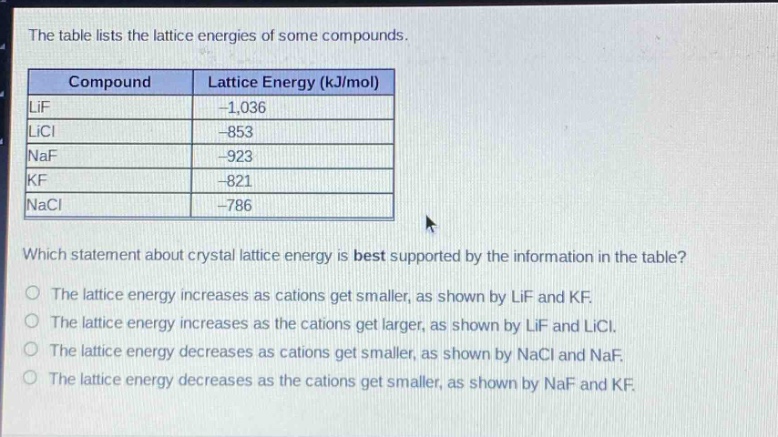
the table lists the lattice energies of some compounds.\n| compound | lattice energy (kj/mol) |\n|--|--|\n| lif | -1,036 |\n| licl | -853 |\n| naf | -923 |\n| kf | -821 |\n| nacl | -786 |\nwhich statement about crystal lattice energy is best supported by the information in the table?\no the lattice energy increases as cations get smaller, as shown by lif and kf.\no the lattice energy increases as the cations get larger, as shown by lif and licl.\no the lattice energy decreases as cations get smaller, as shown by nacl and naf.\no the lattice energy decreases as the cations get smaller, as shown by naf and kf.
Answer
Explanation:
Step1: Analyze LiF and KF
Li⁺ has a smaller ionic radius than K⁺. The lattice - energy of LiF (-1036 kJ/mol) is more negative (higher in magnitude) than that of KF (-821 kJ/mol). A more negative lattice energy means a stronger ionic bond. As the cation gets smaller (from K⁺ to Li⁺), the lattice energy increases.
Step2: Analyze other pairs for comparison
For LiF and LiCl, the anions are different (F⁻ and Cl⁻), so it's not a valid comparison for the effect of cation size on lattice energy. For NaCl and NaF, the cations are the same (Na⁺), so it doesn't show the effect of cation size on lattice energy. For NaF and KF, as the cation size increases from Na⁺ to K⁺, the lattice energy decreases, which is contrary to the wrong statements in the options.
Answer:
The lattice energy increases as cations get smaller, as shown by LiF and KF.