7. table salt can be melted. if an electric current passes through melted sodium chloride, a chemical…
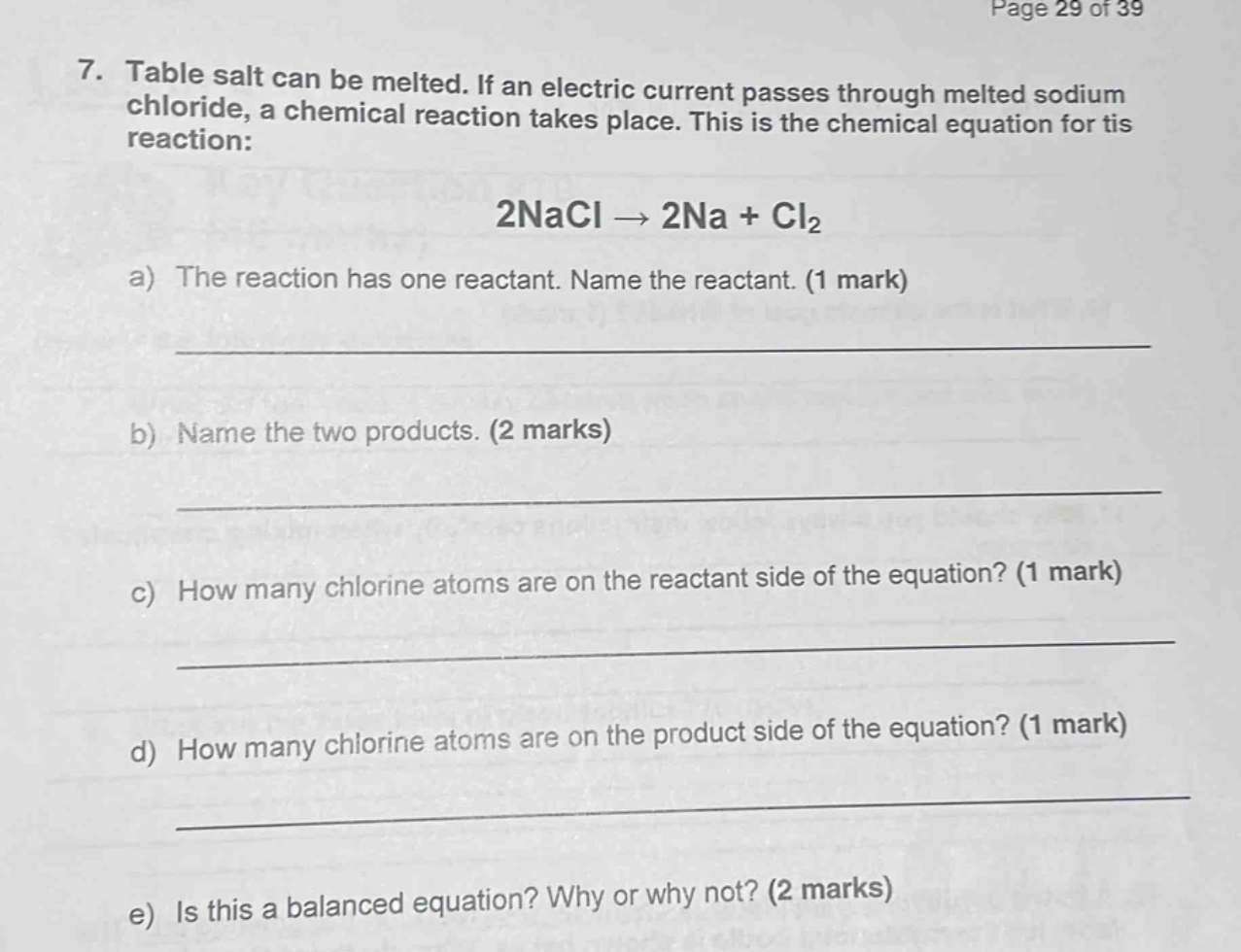
7. table salt can be melted. if an electric current passes through melted sodium chloride, a chemical reaction takes place. this is the chemical equation for tis reaction: 2nacl → 2na + cl₂\na) the reaction has one reactant. name the reactant. (1 mark)\n____________________\nb) name the two products. (2 marks)\n____________________\nc) how many chlorine atoms are on the reactant side of the equation? (1 mark)\n____________________\nd) how many chlorine atoms are on the product side of the equation? (1 mark)\n____________________\ne) is this a balanced equation? why or why not? (2 marks)\n____________________
Answer
Explanation:
Step1: Identify reactant
In a chemical equation, reactants are on the left - hand side. For $2NaCl\rightarrow2Na + Cl_2$, the reactant is sodium chloride ($NaCl$).
Step2: Identify products
Products are on the right - hand side. The products are sodium ($Na$) and chlorine gas ($Cl_2$).
Step3: Count chlorine atoms on reactant side
In $2NaCl$, the coefficient 2 multiplies the 1 chlorine atom in each $NaCl$ unit, so there are $2\times1 = 2$ chlorine atoms.
Step4: Count chlorine atoms on product side
In $Cl_2$, there are 2 chlorine atoms.
Step5: Check balance
A balanced equation has the same number of each type of atom on both sides. Sodium: 2 on reactant side and 2 on product side. Chlorine: 2 on reactant side and 2 on product side. So it is balanced.
Answer:
a) Sodium chloride ($NaCl$) b) Sodium ($Na$), Chlorine gas ($Cl_2$) c) 2 d) 2 e) Yes, because the number of sodium and chlorine atoms is the same on both the reactant and product sides.