terbium - 147 undergoes positron emission to become a stable atom. what is that stable atom?\n$_{65}^{147}tb\…
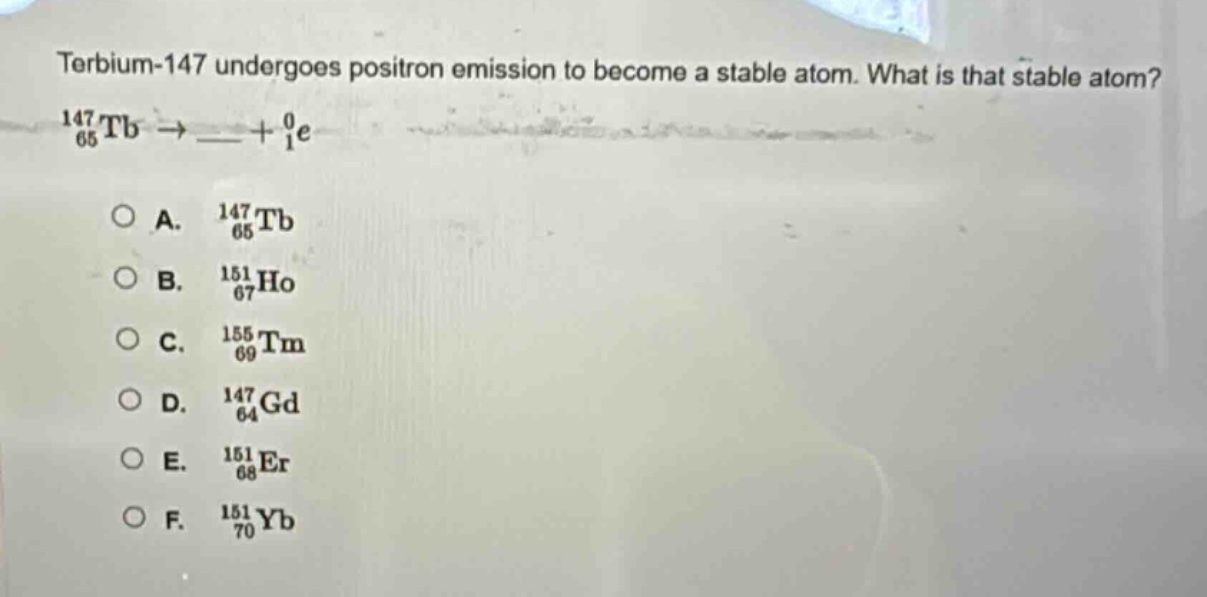
terbium - 147 undergoes positron emission to become a stable atom. what is that stable atom?\n$_{65}^{147}tb\\rightarrow\\_\\_+_{1}^{0}e$\n\na. $_{65}^{147}tb$\nb. $_{67}^{151}ho$\nc. $_{69}^{155}tm$\nd. $_{64}^{147}gd$\ne. $_{68}^{151}er$\nf. $_{70}^{151}yb$
Answer
Explanation:
Step1: Understand positron - emission
In positron emission, a proton in the nucleus is converted into a neutron, a positron ($_{1}^{0}e$) and a neutrino. The mass number ($A$) of the parent and daughter nuclei remains the same, and the atomic number ($Z$) of the daughter nucleus is one less than that of the parent nucleus.
Step2: Identify parent - nucleus properties
The parent nucleus is $_{65}^{147}Tb$. Here, the mass number $A = 147$ and the atomic number $Z=65$.
Step3: Calculate daughter - nucleus atomic number
Since positron emission occurs, the atomic number of the daughter nucleus is $Z_{daughter}=Z_{parent}- 1=65 - 1=64$.
Step4: Determine the element
The element with atomic number $Z = 64$ is Gadolinium (Gd). The mass number remains $A = 147$. So the daughter nucleus is $_{64}^{147}Gd$.
Answer:
D. $_{64}^{147}Gd$