text 1: crop rotation is a vital practice for sustainable agriculture. by rotating different crops in and…
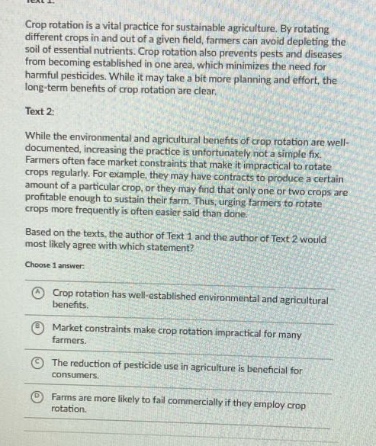
text 1: crop rotation is a vital practice for sustainable agriculture. by rotating different crops in and out of a given field, farmers can avoid depleting the soil of essential nutrients. crop rotation also prevents pests and diseases from becoming established in one area, which minimizes the need for harmful pesticides. while it may take a bit more planning and effort, the long - term benefits of crop rotation are clear. text 2: while the environmental and agricultural benefits of crop rotation are well - documented, increasing the practice is unfortunately not so simple. farmers often face market constraints that make it impractical to rotate crops regularly. for example, they may have contracts to produce a certain amount of a particular crop, or they may find that only one or two crops are profitable enough to sustain their farm. thus, urging farmers to rotate crops more frequently is often easier said than done. based on the texts, the author of text 1 and the author of text 2 would most likely agree with which statement? choose 1 answer: a crop rotation has well - established environmental and agricultural benefits. b market constraints make crop rotation impractical for many farmers. c the reduction of pesticide use in agriculture is beneficial for consumers. d farms are more likely to fail commercially if they employ crop rotation.
Answer
Brief Explanations:
Text 1 mentions crop rotation helps with soil nutrient - conservation and pest/disease prevention. Text 2 states the environmental and agricultural benefits of crop rotation are well - documented. Option A aligns with this as both texts imply the benefits are well - established. Option B is only from Text 2. Option C is not the main focus of either text. Option D is not supported by the texts.
Answer:
A. Crop rotation has well - established environmental and agricultural benefits.