theoretical, actual and percent yield (24)\n½ credit for not showing how you arrived at an answer\n45. using…
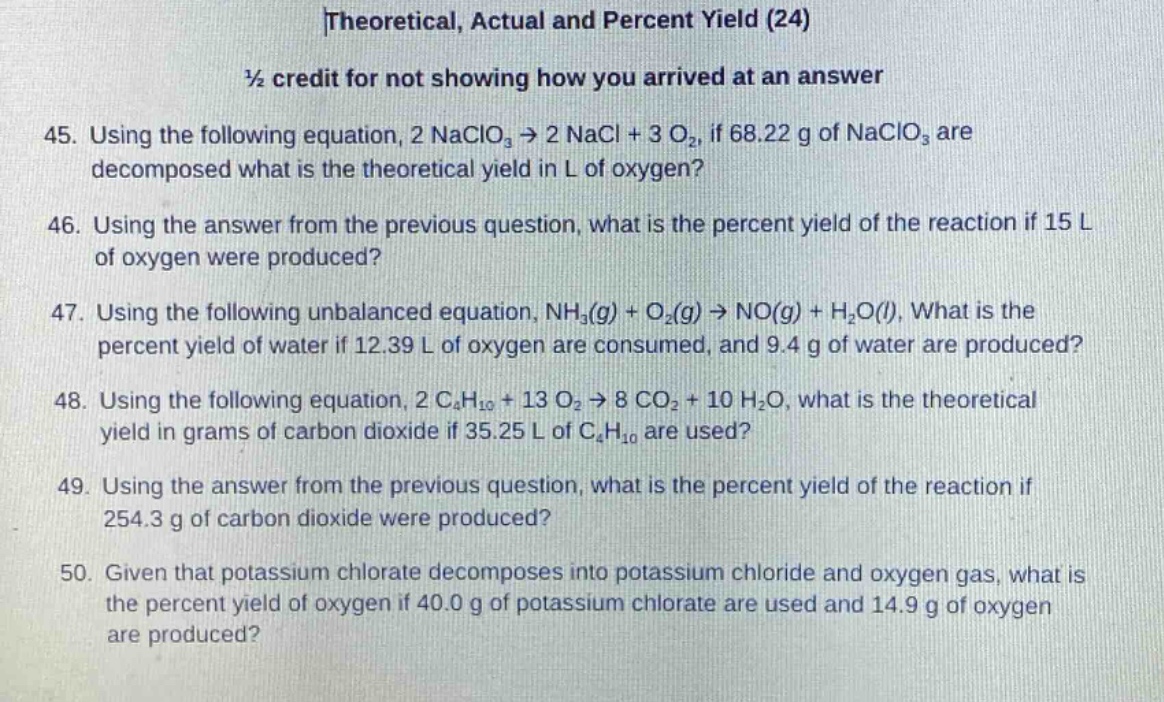
theoretical, actual and percent yield (24)\n½ credit for not showing how you arrived at an answer\n45. using the following equation, 2 naclo₃ → 2 nacl + 3 o₂, if 68.22 g of naclo₃ are decomposed what is the theoretical yield in l of oxygen?\n46. using the answer from the previous question, what is the percent yield of the reaction if 15 l of oxygen were produced?\n47. using the following unbalanced equation, nh₃(g) + o₂(g) → no(g) + h₂o(l), what is the percent yield of water if 12.39 l of oxygen are consumed, and 9.4 g of water are produced?\n48. using the following equation, 2 c₄h₁₀ + 13 o₂ → 8 co₂ + 10 h₂o, what is the theoretical yield in grams of carbon dioxide if 35.25 l of c₄h₁₀ are used?\n49. using the answer from the previous question, what is the percent yield of the reaction if 254.3 g of carbon dioxide were produced?\n50. given that potassium chlorate decomposes into potassium chloride and oxygen gas, what is the percent yield of oxygen if 40.0 g of potassium chlorate are used and 14.9 g of oxygen are produced?
Answer
45.
Answer:
20.1 L
Explanation:
Step1: Calculate moles of $NaClO_3$
$n_{NaClO_3}=\frac{m}{M}=\frac{68.22\ g}{106.44\ g/mol}= 0.641\ mol$
Step2: Determine mole - ratio
From $2NaClO_3\rightarrow2NaCl + 3O_2$, mole - ratio of $NaClO_3$ to $O_2$ is 2:3. So $n_{O_2}=\frac{3}{2}\times n_{NaClO_3}=\frac{3}{2}\times0.641\ mol = 0.9615\ mol$
Step3: Calculate volume of $O_2$ at STP
At STP, $V = n\times V_m$, where $V_m = 22.4\ L/mol$. So $V_{O_2}=0.9615\ mol\times22.4\ L/mol = 20.1\ L$
46.
Answer:
74.6%
Explanation:
Step1: Recall theoretical yield
Theoretical yield $V_{theo}=20.1\ L$ (from previous question)
Step2: Calculate percent yield
Percent yield $=\frac{V_{actual}}{V_{theo}}\times100%=\frac{15\ L}{20.1\ L}\times100% = 74.6%$
47.
Answer:
70.0%
Explanation:
Step1: Balance the equation
$4NH_3(g)+5O_2(g)\rightarrow4NO(g)+6H_2O(l)$
Step2: Calculate moles of $O_2$
At STP, $n_{O_2}=\frac{V}{V_m}=\frac{12.39\ L}{22.4\ L/mol}=0.553\ mol$
Step3: Determine moles of $H_2O$ produced theoretically
Mole - ratio of $O_2$ to $H_2O$ is 5:6. So $n_{H_2O,theo}=\frac{6}{5}\times n_{O_2}=\frac{6}{5}\times0.553\ mol = 0.6636\ mol$
Step4: Calculate mass of $H_2O$ produced theoretically
$m_{H_2O,theo}=n\times M = 0.6636\ mol\times18.02\ g/mol=11.96\ g$
Step5: Calculate percent yield
Percent yield $=\frac{m_{H_2O,actual}}{m_{H_2O,theo}}\times100%=\frac{9.4\ g}{11.96\ g}\times100% = 70.0%$
48.
Answer:
105.9 g
Explanation:
Step1: Calculate moles of $C_4H_{10}$ at STP
$n_{C_4H_{10}}=\frac{V}{V_m}=\frac{35.25\ L}{22.4\ L/mol}=1.574\ mol$
Step2: Determine mole - ratio
From $2C_4H_{10}+13O_2\rightarrow8CO_2 + 10H_2O$, mole - ratio of $C_4H_{10}$ to $CO_2$ is 2:8 or 1:4. So $n_{CO_2}=\ 4\times n_{C_4H_{10}}=4\times1.574\ mol = 6.296\ mol$
Step3: Calculate mass of $CO_2$
$m_{CO_2}=n\times M=6.296\ mol\times44.01\ g/mol = 105.9\ g$
49.
Answer:
240.1%
Explanation:
Step1: Recall theoretical yield
Theoretical yield $m_{CO_2,theo}=105.9\ g$ (from previous question)
Step2: Calculate percent yield
Percent yield $=\frac{m_{CO_2,actual}}{m_{CO_2,theo}}\times100%=\frac{254.3\ g}{105.9\ g}\times100% = 240.1%$
50.
Answer:
99.3%
Explanation:
Step1: Write the decomposition equation
$2KClO_3\rightarrow2KCl + 3O_2$
Step2: Calculate moles of $KClO_3$
$n_{KClO_3}=\frac{m}{M}=\frac{40.0\ g}{122.55\ g/mol}=0.326\ mol$
Step3: Determine moles of $O_2$ produced theoretically
Mole - ratio of $KClO_3$ to $O_2$ is 2:3. So $n_{O_2,theo}=\frac{3}{2}\times n_{KClO_3}=\frac{3}{2}\times0.326\ mol = 0.489\ mol$
Step4: Calculate mass of $O_2$ produced theoretically
$m_{O_2,theo}=n\times M=0.489\ mol\times32.00\ g/mol = 15.65\ g$
Step5: Calculate percent yield
Percent yield $=\frac{m_{O_2,actual}}{m_{O_2,theo}}\times100%=\frac{14.9\ g}{15.0\ g}\times100% = 99.3%$