what are the trends and exceptions to the trends in electron affinity? check all that apply. the electron…
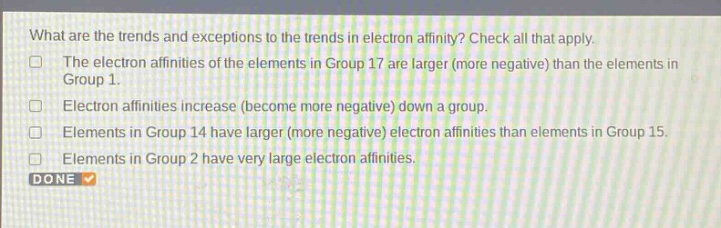
what are the trends and exceptions to the trends in electron affinity? check all that apply. the electron affinities of the elements in group 17 are larger (more negative) than the elements in group 1. electron affinities increase (become more negative) down a group. elements in group 14 have larger (more negative) electron affinities than elements in group 15. elements in group 2 have very large electron affinities. done
Answer
Brief Explanations:
- Electron affinity is the energy change when an electron is added to a neutral atom in the gaseous state. Group 17 (halogens) have high electron - affinities as they are one electron short of a stable noble - gas configuration, while Group 1 (alkali metals) have relatively low electron - affinities as they prefer to lose an electron. So, the electron affinities of elements in Group 17 are larger (more negative) than those in Group 1.
- Electron affinities generally decrease (become less negative) down a group due to increased atomic size and shielding, not increase.
- Elements in Group 14 have larger (more negative) electron affinities than those in Group 15 because in Group 15, the p - subshell is half - filled, which is a relatively stable configuration, making it less favorable to add an electron compared to Group 14.
- Elements in Group 2 have very small electron affinities as they have a stable s - subshell configuration and adding an electron would disrupt this stability.
Answer:
The electron affinities of the elements in Group 17 are larger (more negative) than the elements in Group 1. Elements in Group 14 have larger (more negative) electron affinities than elements in Group 15.