what are the trends and exceptions to the trends in electron affinity? check all that apply.\nthe electron…
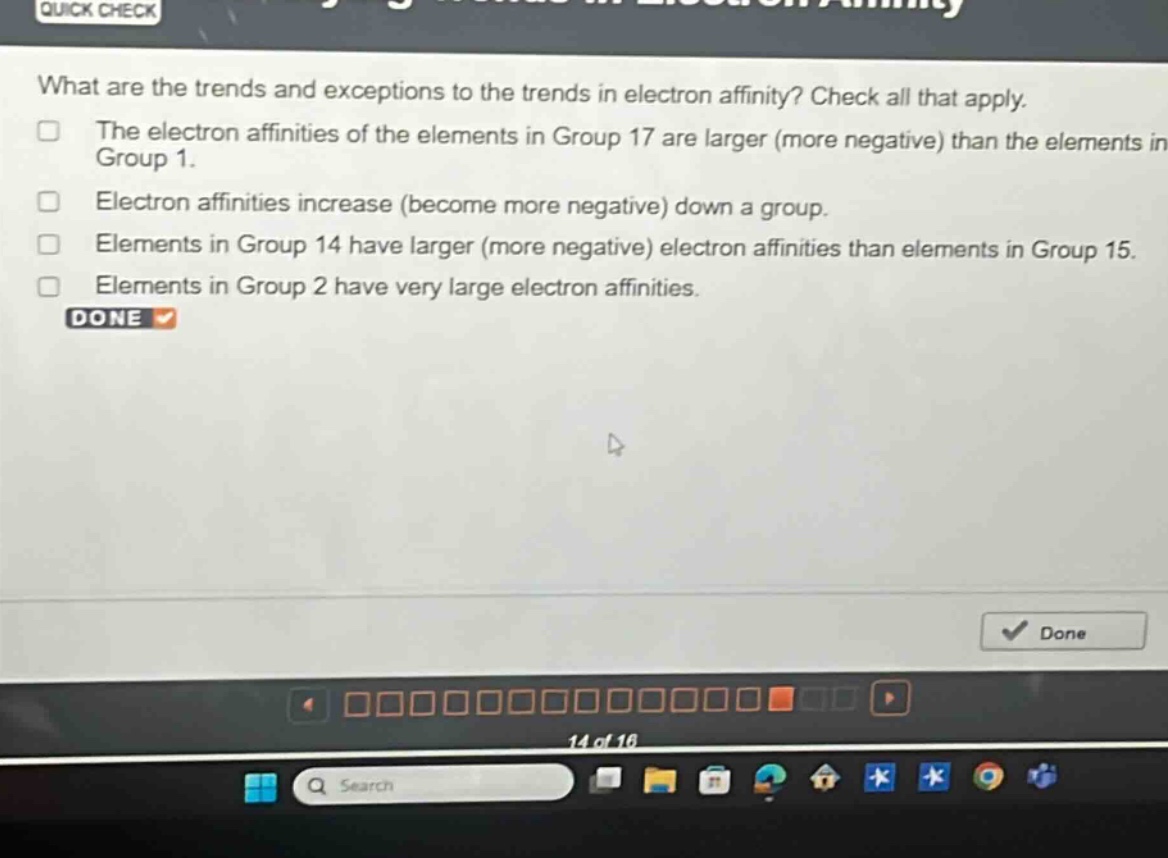
what are the trends and exceptions to the trends in electron affinity? check all that apply.\nthe electron affinities of the elements in group 17 are larger (more negative) than the elements in group 1.\nelectron affinities increase (become more negative) down a group.\nelements in group 14 have larger (more negative) electron affinities than elements in group 15.\nelements in group 2 have very large electron affinities.\ndone
Answer
Brief Explanations:
- Group 17 elements (halogens) have a strong tendency to gain an electron to achieve a stable noble - gas configuration, so their electron affinities are more negative than Group 1 (alkali metals) which lose electrons easily.
- Electron affinities generally decrease (become less negative) down a group due to increased atomic size and shielding.
- Elements in Group 14 have p - orbitals that are half - filled when an electron is added, while Group 15 has half - filled p - orbitals in their ground state. Adding an electron to Group 15 disrupts the stable half - filled configuration, so Group 14 has more negative electron affinities.
- Group 2 elements have a stable s - orbital configuration and adding an electron is energetically unfavorable, so they have very small electron affinities.
Answer:
The electron affinities of the elements in Group 17 are larger (more negative) than the elements in Group 1.; Elements in Group 14 have larger (more negative) electron affinities than elements in Group 15.