why are the trends and exceptions to the trends in ionization energy observed? check all that…
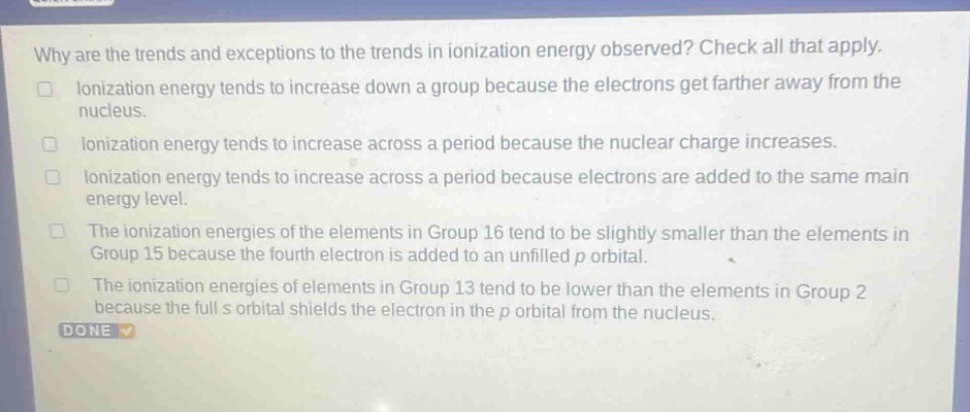
why are the trends and exceptions to the trends in ionization energy observed? check all that apply.\nionization energy tends to increase down a group because the electrons get farther away from the nucleus.\nionization energy tends to increase across a period because the nuclear charge increases.\nionization energy tends to increase across a period because electrons are added to the same main energy level.\nthe ionization energies of the elements in group 16 tend to be slightly smaller than the elements in group 15 because the fourth electron is added to an unfilled p orbital.\nthe ionization energies of elements in group 13 tend to be lower than the elements in group 2 because the full s orbital shields the electron in the p orbital from the nucleus.\ndone
Answer
Brief Explanations:
- Ionization energy decreases down a group as electrons are farther from the nucleus and less tightly held, so the first statement is false.
- Across a period, nuclear charge increases while electrons are added to the same main - energy level, making it harder to remove an electron, thus ionization energy increases. So, the second and third statements are true.
- In Group 16, the fourth p - electron is added to a filled p - orbital, causing electron - electron repulsion and making it easier to remove an electron compared to Group 15 where p - orbitals are half - filled and more stable. So, the fourth statement is false.
- In Group 13, the full s - orbital shields the p - electron from the nucleus, making it easier to remove the p - electron compared to Group 2, resulting in lower ionization energy for Group 13. So, the fifth statement is true.
Answer:
B. Ionization energy tends to increase across a period because the nuclear charge increases. C. Ionization energy tends to increase across a period because electrons are added to the same main energy level. E. The ionization energies of elements in Group 13 tend to be lower than the elements in Group 2 because the full s orbital shields the electron in the p orbital from the nucleus.