trevor dissolves sodium hydroxide pellets in a beaker of water at room temperature, and notes that the…
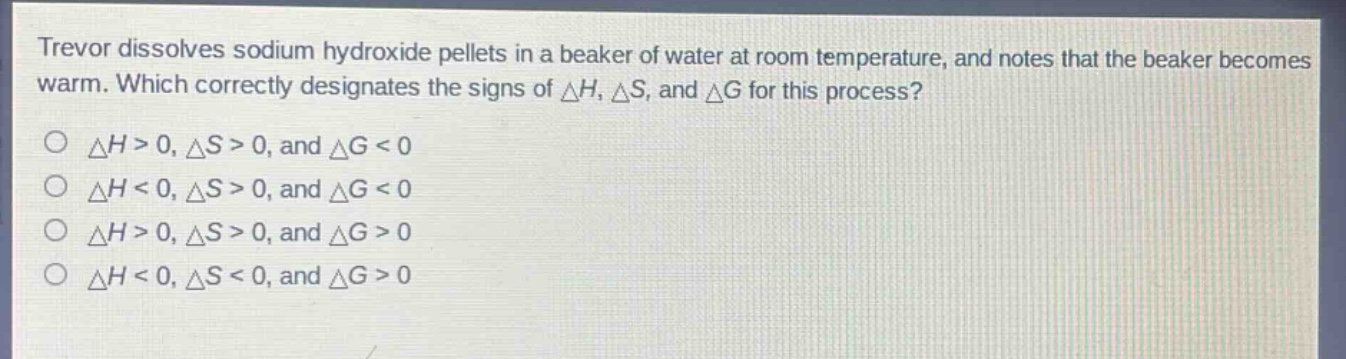
trevor dissolves sodium hydroxide pellets in a beaker of water at room temperature, and notes that the beaker becomes warm. which correctly designates the signs of $delta h$, $delta s$, and $delta g$ for this process?\n$delta h>0, delta s>0$, and $delta g<0$\n$delta h<0, delta s>0$, and $delta g<0$\n$delta h>0, delta s>0$, and $delta g>0$\n$delta h<0, delta s<0$, and $delta g>0$
Answer
Answer:
B. $\Delta H<0$, $\Delta S>0$, and $\Delta G<0$
Explanation:
Step1: Analyze $\Delta H$
The beaker becomes warm, indicating an exothermic process. So $\Delta H < 0$.
Step2: Analyze $\Delta S$
Sodium - hydroxide pellets dissolve in water, going from a more ordered solid - state to a more disordered aqueous - state. So $\Delta S>0$.
Step3: Analyze $\Delta G$
The dissolution occurs spontaneously at room temperature. The Gibbs free energy equation is $\Delta G=\Delta H - T\Delta S$. Since $\Delta H < 0$ and $\Delta S>0$, at room temperature ($T>0$), $\Delta G=\Delta H - T\Delta S<0$.