true or false: (2 pts each)\n1) a glass of ice water containing nine ice cubes will be colder than a similar…
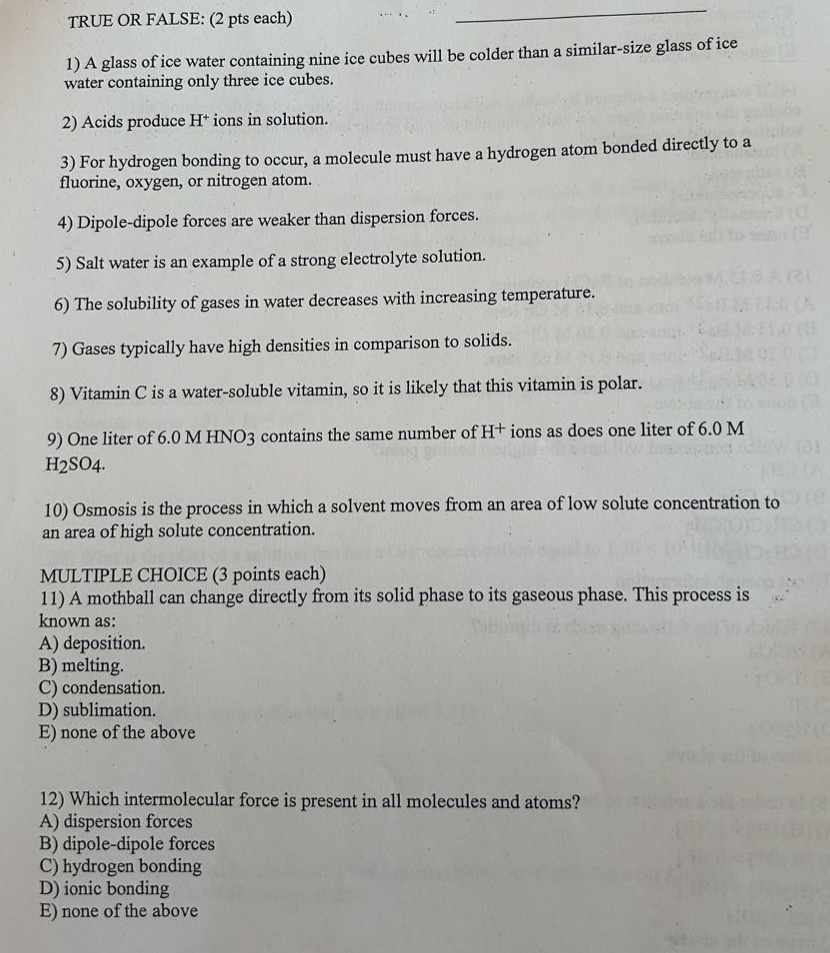
true or false: (2 pts each)\n1) a glass of ice water containing nine ice cubes will be colder than a similar - size glass of ice water containing only three ice cubes.\n2) acids produce h+ ions in solution.\n3) for hydrogen bonding to occur, a molecule must have a hydrogen atom bonded directly to a fluorine, oxygen, or nitrogen atom.\n4) dipole - dipole forces are weaker than dispersion forces.\n5) salt water is an example of a strong electrolyte solution.\n6) the solubility of gases in water decreases with increasing temperature.\n7) gases typically have high densities in comparison to solids.\n8) vitamin c is a water - soluble vitamin, so it is likely that this vitamin is polar.\n9) one liter of 6.0 m hno3 contains the same number of h+ ions as does one liter of 6.0 m h2so4.\n10) osmosis is the process in which a solvent moves from an area of low solute concentration to an area of high solute concentration.\nmultiple choice (3 points each)\n11) a mothball can change directly from its solid phase to its gaseous phase. this process is known as:\na) deposition.\nb) melting.\nc) condensation.\nd) sublimation.\ne) none of the above\n12) which intermolecular force is present in all molecules and atoms?\na) dispersion forces\nb) dipole - dipole forces\nc) hydrogen bonding\nd) ionic bonding\ne) none of the above
Answer
Brief Explanations:
- The temperature of ice - water mixtures at equilibrium is the same regardless of the number of ice cubes, so it's false.
- By definition, acids produce H⁺ ions in solution, so it's true.
- Hydrogen bonding requires a hydrogen atom bonded directly to F, O, or N, so it's true.
- Dipole - dipole forces are generally stronger than dispersion forces for molecules of similar size, so it's false.
- Salt (NaCl) dissociates completely in water, making salt water a strong electrolyte solution, so it's true.
- The solubility of gases in water decreases with increasing temperature, so it's true.
- Gases typically have low densities compared to solids, so it's false.
- Water - soluble substances are often polar, so since vitamin C is water - soluble, it's likely polar, so it's true.
- HNO₃ is a monoprotic acid and H₂SO₄ is a diprotic acid. One liter of 6.0 M H₂SO₄ has twice the number of H⁺ ions as one liter of 6.0 M HNO₃, so it's false.
- Osmosis is the movement of a solvent from an area of high solvent concentration (low solute concentration) to an area of low solvent concentration (high solute concentration), so it's false.
- The direct change from solid to gas is sublimation, so the answer is D.
- Dispersion forces are present in all molecules and atoms, so the answer is A.
Answer:
- False
- True
- True
- False
- True
- True
- False
- True
- False
- False
- D. sublimation
- A. dispersion forces