which is true of transition metals when moving from left to right on the periodic table?\no the d sublevels…
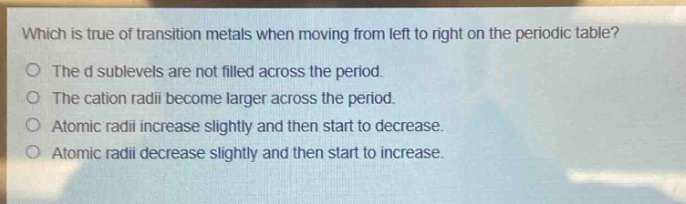
which is true of transition metals when moving from left to right on the periodic table?\no the d sublevels are not filled across the period.\no the cation radii become larger across the period.\no atomic radii increase slightly and then start to decrease.\no atomic radii decrease slightly and then start to increase.
Answer
Answer:
The d sublevels are not filled across the period.
Explanation:
Step1: Analyze d - sublevel filling
In transition - metal periods, the d - sublevel is gradually filled as we move from left to right, but not completely filled across the period. For example, in the first transition series (Sc - Zn), the 3d sublevel is being filled along with the 4s sublevel.
Step2: Analyze cation radii
As we move from left to right across a period of transition metals, the effective nuclear charge increases. Cations are formed by losing electrons. With an increase in effective nuclear charge, the attraction for the remaining electrons is stronger, and cation radii decrease across the period, not increase.
Step3: Analyze atomic radii
As we move from left to right across a period of transition metals, the number of protons in the nucleus increases, and electrons are added to the inner d - orbitals. The shielding effect of the d - electrons is not very effective. So, the effective nuclear charge increases, and atomic radii decrease slightly across the period, not increase first and then decrease or decrease first and then increase.