two representations of the distribution of electrons in the potassium atom are shown.\nmodel…
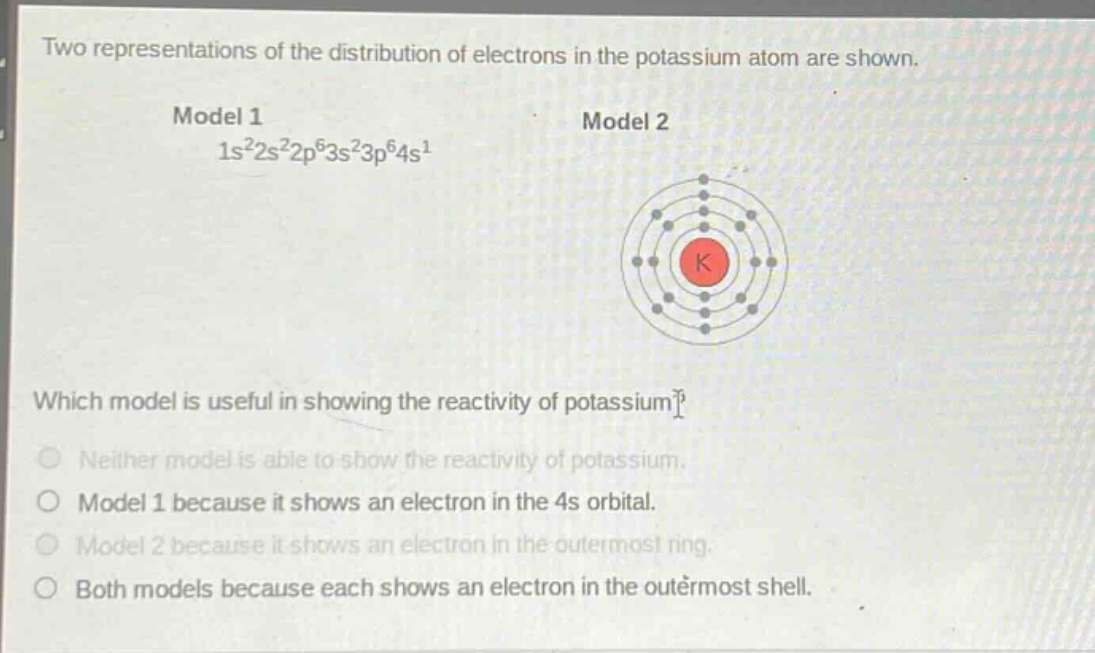
two representations of the distribution of electrons in the potassium atom are shown.\nmodel 1\n1s²2s²2p⁶3s²3p⁶4s¹\nmodel 2\n\nwhich model is useful in showing the reactivity of potassium?\nneither model is able to show the reactivity of potassium.\nmodel 1 because it shows an electron in the 4s orbital.\nmodel 2 because it shows an electron in the outermost ring.\nboth models because each shows an electron in the outermost shell.
Answer
Brief Explanations:
The chemical reactivity of an element is primarily determined by its valence electrons, which are the electrons in the outermost energy shell. Model 1, the electron configuration ($1s^22s^22p^63s^23p^64s^1$), shows that the highest principal energy level occupied is $n=4$, and there is one electron ($4s^1$) in this outermost shell. Model 2, the Bohr model representation, visually depicts the electron shells around the nucleus (K for potassium). It clearly shows one electron in the outermost ring (shell). Since both models indicate the presence of a single electron in the outermost shell, both are useful in illustrating why potassium is reactive (it tends to lose this one valence electron).
Answer:
Both models because each shows an electron in the outermost shell.