unit 2: chemical reactions and stoichiometric relationships\n3. hematite is an iron ore containing 84.8%…
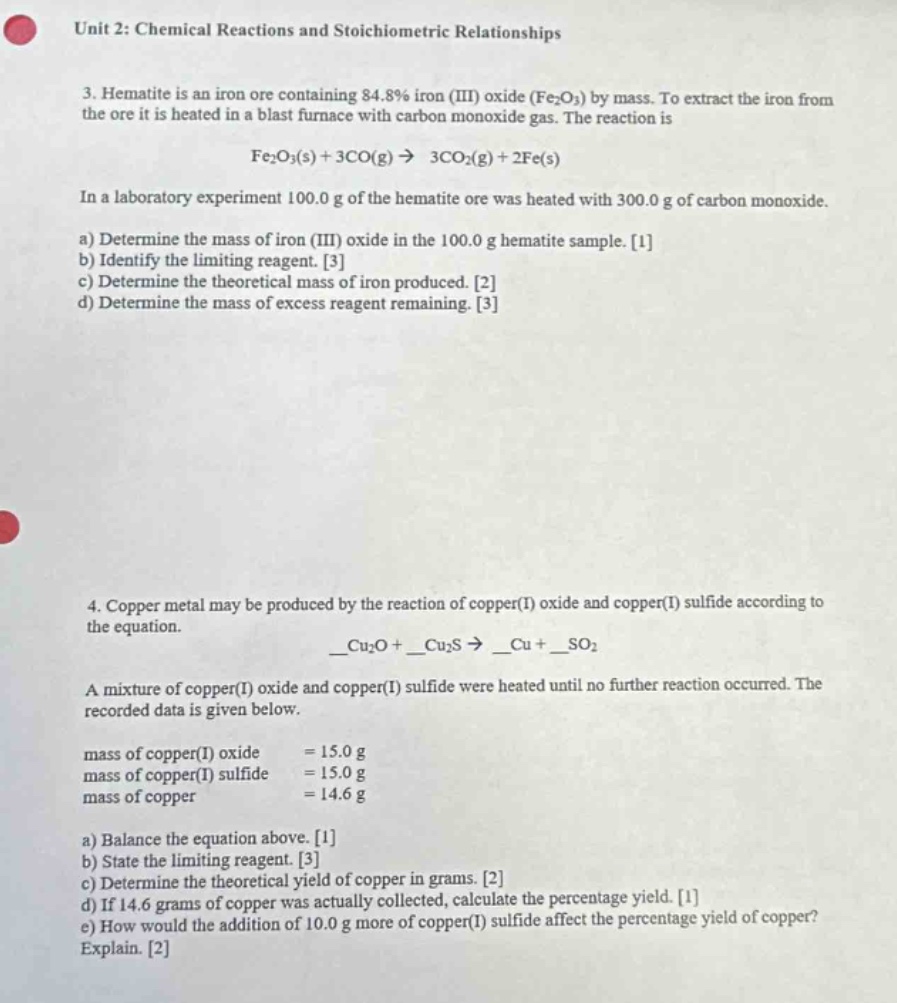
unit 2: chemical reactions and stoichiometric relationships\n3. hematite is an iron ore containing 84.8% iron (iii) oxide (fe₂o₃) by mass. to extract the iron from the ore it is heated in a blast furnace with carbon monoxide gas. the reaction is\nfe₂o₃(s) + 3co(g) → 3co₂(g) + 2fe(s)\nin a laboratory experiment 100.0 g of the hematite ore was heated with 300.0 g of carbon monoxide.\na) determine the mass of iron (iii) oxide in the 100.0 g hematite sample. 1\nb) identify the limiting reagent. 3\nc) determine the theoretical mass of iron produced. 2\nd) determine the mass of excess reagent remaining. 3\n4. copper metal may be produced by the reaction of copper(i) oxide and copper(i) sulfide according to the equation.\n__cu₂o + __cu₂s → __cu + __so₂\na mixture of copper(i) oxide and copper(i) sulfide were heated until no further reaction occurred. the recorded data is given below.\nmass of copper(i) oxide = 15.0 g\nmass of copper(i) sulfide = 15.0 g\nmass of copper = 14.6 g\na) balance the equation above. 1\nb) state the limiting reagent. 3\nc) determine the theoretical yield of copper in grams. 2\nd) if 14.6 grams of copper was actually collected, calculate the percentage yield. 1\ne) how would the addition of 10.0 g more of copper(i) sulfide affect the percentage yield of copper? explain. 2
Answer
3.
Explanation:
Step1: Calculate mass of iron(III) oxide
Given hematite is 84.8% iron(III) oxide by mass. For 100.0 g hematite, mass of $Fe_2O_3$ is $100.0\times0.848 = 84.8$ g.
Step2: Calculate moles of reactants
Molar mass of $Fe_2O_3$ is $M_{Fe_2O_3}=2\times55.85 + 3\times16=159.7$ g/mol. Moles of $Fe_2O_3$, $n_{Fe_2O_3}=\frac{84.8}{159.7}\approx0.531$ mol. Molar mass of $CO$ is $M_{CO}=12 + 16 = 28$ g/mol. Moles of $CO$, $n_{CO}=\frac{300.0}{28}\approx10.71$ mol. From the reaction $Fe_2O_3(s)+3CO(g)\to3CO_2(g) + 2Fe(s)$, mole - ratio of $Fe_2O_3$ to $CO$ is 1:3. For 0.531 mol of $Fe_2O_3$, moles of $CO$ required is $0.531\times3 = 1.593$ mol. Since $1.593<10.71$, $Fe_2O_3$ is the limiting reagent.
Step3: Calculate theoretical mass of iron
From the reaction, 1 mol of $Fe_2O_3$ produces 2 mol of $Fe$. Moles of $Fe$ produced from 0.531 mol of $Fe_2O_3$ is $n_{Fe}=0.531\times2 = 1.062$ mol. Molar mass of $Fe$ is 55.85 g/mol. Mass of $Fe$ produced, $m_{Fe}=1.062\times55.85\approx59.3$ g.
Step4: Calculate mass of excess reagent remaining
Moles of $CO$ reacted is 1.593 mol. Moles of $CO$ remaining is $n_{CO_{remaining}}=10.71 - 1.593 = 9.117$ mol. Mass of $CO$ remaining is $m_{CO_{remaining}}=9.117\times28\approx255.3$ g.
Answer:
a) 84.8 g b) $Fe_2O_3$ c) 59.3 g d) 255.3 g
4.
Explanation:
Step1: Balance the equation
$2Cu_2O+Cu_2S\to6Cu + SO_2$
Step2: Calculate moles of reactants
Molar mass of $Cu_2O$ is $M_{Cu_2O}=2\times63.55+16 = 143.1$ g/mol. Moles of $Cu_2O$, $n_{Cu_2O}=\frac{15.0}{143.1}\approx0.105$ mol. Molar mass of $Cu_2S$ is $M_{Cu_2S}=2\times63.55 + 32.07=159.17$ g/mol. Moles of $Cu_2S$, $n_{Cu_2S}=\frac{15.0}{159.17}\approx0.094$ mol. From the balanced reaction, mole - ratio of $Cu_2O$ to $Cu_2S$ is 2:1. For 0.094 mol of $Cu_2S$, moles of $Cu_2O$ required is $0.094\times2 = 0.188$ mol. Since $0.105<0.188$, $Cu_2O$ is the limiting reagent.
Step3: Calculate theoretical yield of copper
From the balanced reaction, 2 mol of $Cu_2O$ produces 6 mol of $Cu$. Moles of $Cu$ produced from 0.105 mol of $Cu_2O$ is $n_{Cu}=\frac{6}{2}\times0.105 = 0.315$ mol. Molar mass of $Cu$ is 63.55 g/mol. Mass of $Cu$ produced (theoretical yield), $m_{Cu}=0.315\times63.55\approx20.0$ g.
Step4: Calculate percentage yield
Percentage yield $=\frac{14.6}{20.0}\times100% = 73.0%$
Step5: Analyze effect of adding more $Cu_2S$
Since $Cu_2O$ is the limiting reagent, adding more $Cu_2S$ will not affect the amount of $Cu$ produced as the amount of product is determined by the amount of the limiting reagent. So the percentage yield will remain the same.
Answer:
a) $2Cu_2O+Cu_2S\to6Cu + SO_2$ b) $Cu_2O$ c) 20.0 g d) 73.0% e) The percentage yield will remain the same because $Cu_2O$ is the limiting reagent and the amount of product is determined by the amount of the limiting reagent.