use the activity series below to predict the products of each of the following reactions. you do not need to…
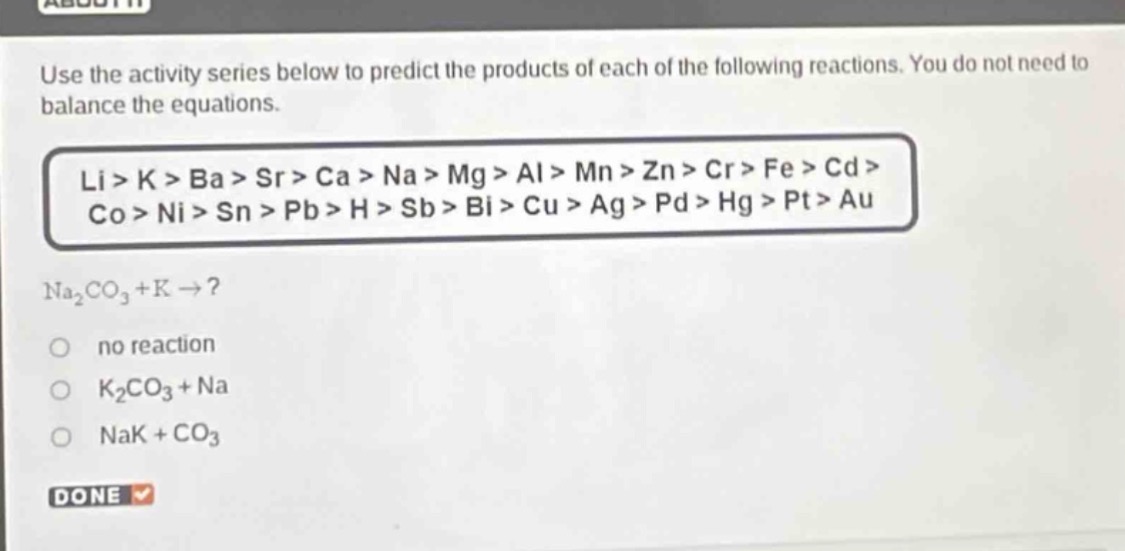
use the activity series below to predict the products of each of the following reactions. you do not need to balance the equations.\nli > k > ba > sr > ca > na > mg > al > mn > zn > cr > fe > cd > co > ni > sn > pb > h > sb > bi > cu > ag > pd > hg > pt > au\nna₂co₃ + k →?\nno reaction\nk₂co₃ + na\nnak + co₃
Answer
Explanation:
Step1: Check activity series
Potassium (K) is more reactive than sodium (Na) according to the given activity series ($\text{Li}>\text{K}>\text{Ba}>\text{Sr}>\text{Ca}>\text{Na}>\text{Mg}>\text{Al}>\text{Mn}>\text{Zn}>\text{Cr}>\text{Fe}>\text{Cd}>\text{Co}>\text{Ni}>\text{Sn}>\text{Pb}>\text{H}>\text{Sb}>\text{Bi}>\text{Cu}>\text{Ag}>\text{Pd}>\text{Hg}>\text{Pt}>\text{Au}$).
Step2: Determine reaction type
This is a single - displacement reaction where a more reactive metal (K) will displace a less reactive metal (Na) from its compound ($\text{Na}_2\text{CO}_3$).
Step3: Predict products
The products will be potassium carbonate ($\text{K}_2\text{CO}_3$) and sodium (Na).
Answer:
$\text{K}_2\text{CO}_3+\text{Na}$