use the equation below to answer the following question. how many grams of hydrogen are necessary to react…
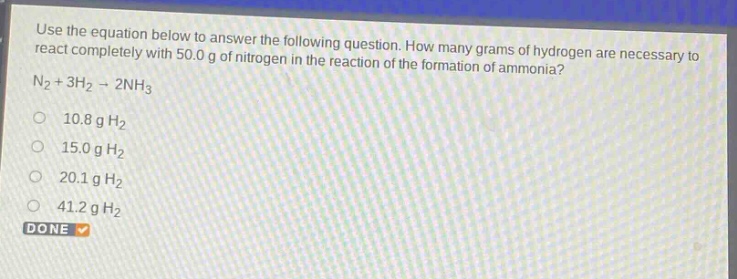
use the equation below to answer the following question. how many grams of hydrogen are necessary to react completely with 50.0 g of nitrogen in the reaction of the formation of ammonia?\nn₂ + 3h₂ → 2nh₃\n10.8 g h₂\n15.0 g h₂\n20.1 g h₂\n41.2 g h₂\ndone
Answer
Explanation:
Step1: Calculate moles of nitrogen
The molar mass of $N_2$ is $M_{N_2}=2\times14.01\ g/mol = 28.02\ g/mol$. The number of moles of $N_2$, $n_{N_2}=\frac{m_{N_2}}{M_{N_2}}$, where $m_{N_2} = 50.0\ g$. So $n_{N_2}=\frac{50.0\ g}{28.02\ g/mol}\approx1.785\ mol$.
Step2: Determine moles of hydrogen
From the balanced chemical equation $N_2 + 3H_2\rightarrow2NH_3$, the mole - ratio of $N_2$ to $H_2$ is $1:3$. So the number of moles of $H_2$, $n_{H_2}=3\times n_{N_2}$. Substituting $n_{N_2}=1.785\ mol$, we get $n_{H_2}=3\times1.785\ mol = 5.355\ mol$.
Step3: Calculate mass of hydrogen
The molar mass of $H_2$ is $M_{H_2}=2\times1.01\ g/mol=2.02\ g/mol$. The mass of $H_2$, $m_{H_2}=n_{H_2}\times M_{H_2}$. Substituting $n_{H_2}=5.355\ mol$ and $M_{H_2}=2.02\ g/mol$, we get $m_{H_2}=5.355\ mol\times2.02\ g/mol\approx10.8\ g$.
Answer:
$10.8\ g\ H_2$