use the following table to answer the question.\n| strong acids | weak acids | weak bases | strong bases…
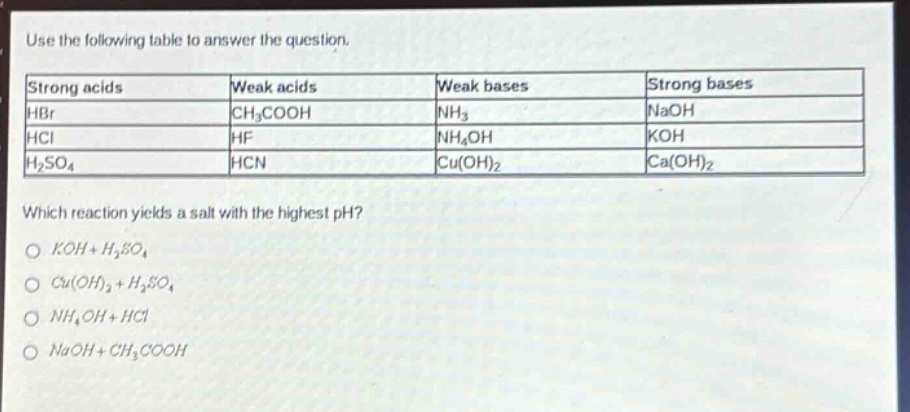
use the following table to answer the question.\n| strong acids | weak acids | weak bases | strong bases |\n| ---- | ---- | ---- | ---- |\n| hbr | ch₃cooh | nh₃ | naoh |\n| hcl | hf | nh₄oh | koh |\n| h₂so₄ | hcn | cu(oh)₂ | ca(oh)₂ |\nwhich reaction yields a salt with the highest ph?\no koh + h₂so₄\no cu(oh)₂ + h₂so₄\no nh₄oh + hcl\no naoh + ch₃cooh
Answer
Answer:
D. $NaOH + CH_3COOH$
Explanation:
Step1: Recall salt - formation and pH concept
Salts are formed from acid - base reactions. A high pH salt comes from a strong base and a weak acid reaction.
Step2: Analyze each option
- Option A: $KOH + H_2SO_4$ is a strong base - strong acid reaction. The salt formed will be neutral.
- Option B: $Cu(OH)_2+H_2SO_4$ is a weak base - strong acid reaction. The salt formed will be acidic.
- Option C: $NH_4OH + HCl$ is a weak base - strong acid reaction. The salt formed will be acidic.
- Option D: $NaOH+CH_3COOH$ is a strong base - weak acid reaction. The salt $CH_3COONa$ will hydrolyze in water to produce $OH^-$ ions, making the solution basic and having a high pH.